

What Are Some Funeral Alternatives to Traditional Burial and Cremation?
July 9th, 2025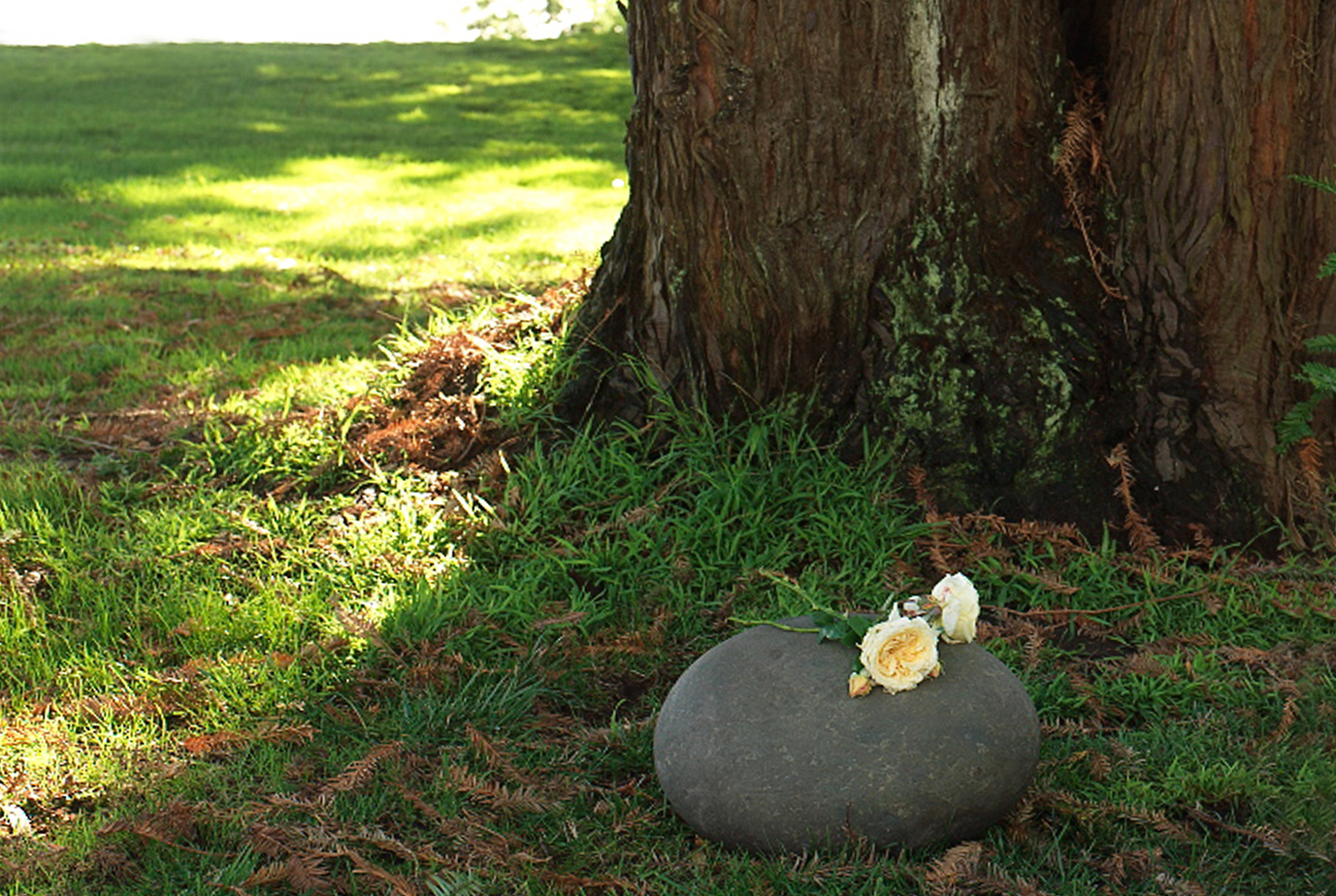
Today, more and more people are searching for funeral alternatives to traditional burial and cremation. Driven by concerns about the environment as well as more personal motives, they are seeking out innovative methods to dispose of their bodies after they die. From green burials to human composting to alkaline hydrolysis and burials at sea, novel methods of final disposition are cropping up all across North America. And while some of them aren’t yet widely available, the death care industry is taking notice of these shifting attitudes and slowly beginning to offer some of these funeral alternatives to consumers.
At SevenPonds, we have noticed that people often confuse what to do with cremation ashes as a disposition method. Cremation is the disposition method, and what to do with cremation ashes is one of the many ways to lay cremation ashes to rest. We wanted our readers to be clear when we present the 9 alternative disposition methods (either viable or theoretical) to conventional burial and cremation are as follows.
Jump ahead to:
- Alternative No. 1 Green or Natural Burial
- Alternative No. 2. Open-Air Funeral Pyre
- Alternative No. 3. Alkaline Hydrolysis or Aquamation
- Alternative No. 4 Burial at Sea
- Alternative No. 5 Cryonic Preservation
- Alternative No. 6. Whole-Body Donation
- Alternative No. 7. Natural Organic Reduction
- Alternative No. 8. Plastination
- Alternative No. 9. Promession
- Why Choose Funeral Alternatives to Burial and Cremation?
Alternative No. 1. Green or Natural Burial
One of the most well-established alternatives to conventional burial and cremation, a green burial or natural burial forgoes the usual trappings of modern body preparation and burial. Bodies buried in a green cemetery are not embalmed and are buried in a shallower grave than they would be in a more traditional cemetery (3 to 4 feet versus 6 feet), without a concrete vault or liner. Caskets, if they are used, are made of biodegradable materials such as wicker, cardboard or unadorned soft wood. In many cases, the body is simply wrapped in a cotton shroud. Additionally, most natural burial grounds don’t permit headstones. The location of the grave may be marked with a rock or tree, or simply noted using GPS coordinates.
At this time, it’s unclear whether natural burial is truly “greener” than burial in a “traditional” cemetery. Although it seems logical that burying tons of concrete, embalming fluid and other chemicals in the ground is bad for the environment, the benefits of avoiding these trappings of the typical American funeral have not been proven scientifically. Nonetheless, the idea of returning to the earth in a more natural state appeals to many consumers today. To learn more about this method of disposition available across the US, visit our section on green burial.
Alternative No. 2. Open-Air Funeral Pyre
Open-air cremations are cremations performed outdoors over an open fire known as a pyre. They are popular in some parts of the world, most notably India, but at this time, the only open-to-the-public open-air funeral pyre in the U.S. is located at the Crestone End-of-Life Project in Crestone, Colorado. Run by the nonprofit Informed Final Choices, the project offers open-air cremations only to residents of Crestone and Saguache counties.
People who have witnessed CEOLP’s outdoor cremations call the experience “transformative,” said Stephanie Gaines, the current director of CEOLP and IFC. Stephanie spoke with SevenPonds about the Crestone End-of-Life Project several years ago. If you’d like to read the complete interview, you can find it in the Professional Advice Column in our magazine.
Alternative No. 3. Alkaline Hydrolysis or Aquamation
Also known as biocremation(™), resomation(™), flameless cremation, green cremation, water cremation, and aquamation, alkaline hydrolysis is a process that uses heated water and an alkaline substance (typically sodium hydroxide or lye) to dissolve a body after death. A widely accepted method of disposing of animal carcasses for years, alkaline hydrolysis (AH) was first used to dispose of human remains that had been donated for medical research at the Mayo Clinic in Rochester, Minnesota, in 2006.
The process and equipment used for alkaline hydrolysis vary somewhat, but are essentially the same:
- After a number of hours in a specially designed chamber, the person’s body is reduced to bones and a sterile liquid about the consistency of motor oil.
- The liquid is then drained and either saved for the family or discarded. According to Texas A&M University, this “effluent” contains no DNA and is free of “all pathogens [disease-causing microorganisms], including the protein coats of viruses, the peptide bonds of prions and vegetative and spore-forming bacteria.”
- Any residual metal (orthopedic hardware, defibrillators, pacemakers) is removed using a magnet. The bones are pulverized as they are in fire-cremation and returned to the family as “ash.”
In some cases, the liquid portion of the remains (known as effluent) is disposed of in municipal wastewater. However, some facilities allow loved ones to take the liquid home, where it can be scattered in a garden along with the ashes, or used in some other way.
Alternative No. 4. Burial at Sea
Sea burial is a form of final disposition in which the remains of a person who died are taken out on a vessel and deposited in the ocean. Typically, the body is either buried in a casket with holes drilled in the side, or wrapped in a biodegradable, weighted shroud to ensure that it sinks as quickly as possible to the ocean floor.
There are a number of companies on both coasts of the United States that provide full-body burials at sea. However, if you have access to a vessel and a skilled crew, you can also conduct a burial at sea yourself. Additionally, the U.S. Navy will assist current and former service members with sea burial, although the process takes quite a while.
The U.S. Environmental Protection Agency regulates sea burials and monitors at-sea disposal of human remains. As a rule, the agency does not require a special permit. The disposition of human remains in ocean waters is covered under a general permit authorized under the Marine Protection, Research and Sanctuaries Act. You must, however, report the burial to the EPA within 30 days.
To learn more about conducting a burial at sea, visit this EPA web page, which outlines the rules around ocean burials and offers tips to help ensure that your experience is a success.
Alternative No. 5 Cryonic Preservation
Cryonics is the process of freezing and preserving a person’s body immediately after legal death with the eventual goal of restoring full function at some time in the future. According to Ben Best’s The History of Cryonics, the concept was introduced in the early part of the 20th century by Robert Ettinger, a physics teacher and long-time science fiction buff. In 1962, Ettinger wrote “The Prospect of Immortality,” which described his theory in detail. However, the book wasn’t published until 1964, when the famous author/scientist Isaac Asimov convinced Doubleday that the concept of cryonics was scientifically sound.
According to Best, the first person in the United States to be cryogenically preserved was Dr. James Bedford, whose body was maintained at the Cryonics Society of California from Jan. 12, 1967, until his body was transferred to Alcor Technologies in 1982. Of the 17 people who were cryopreserved between 1967 and 1973, Bedford is the only one who is still cryogenically preserved. To date no cryonically preserved body has been brought back to life.
At this time, two companies in the United States offer cryonic preservation: Alcor Life Extension Foundation in Scottsdale, Arizona, and Cryonics Institute in Clinton Township, Michigan. Both companies are active and available to answer questions or accept new members.
Alternative No. 6. Whole-Body Donation
Choosing to donate your body for medical research is a noble decision, and there are dozens of medical schools across the country that can help facilitate that wish. The Anatomical Board of the State of Florida has compiled a comprehensive list of these programs that includes the address of the facility and the phone numbers to call. Contact the program nearest you to get more information and enroll.
Although most people are eligible to donate their bodies, some conditions will preclude your acceptance at the time of your death. According to the University of California at Davis, these include (but are not limited to) the following:
- Hepatitis B or C
- HIV/AIDS
- Tuberculosis
- Kuru
- Creutzfeldt-Jakob’s disease
- MRSA/VRSA (methicillin-resistant and vancomycin-resistant Staphylococcus aureus)
- Recent extensive surgery
- Severe trauma
- Obesity
- Severe muscle atrophy
Bodies that have been autopsied or embalmed are generally ineligible as well. Additionally, if the facility you have chosen has a sufficient supply of bodies at the time you or your loved one dies, it may reject the donation despite there being no obvious issues that would preclude its use. In this case, your loved ones may be able to donate your tissues through a local organ procurement organization or a company such as MedCure or Science Care, which coordinates with medical researchers nationwide. However, they, too, may not accept the donation for a variety of reasons, so it’s a good idea to have a backup plan (such as an inexpensive direct cremation) in place.
Alternative No. 7. Natural Organic Reduction
Sometimes referred to as “human composting,” natural organic reduction is a new form of final disposition developed by a team of scientists led by Katrina Spade, the CEO of the public benefit corporation Recompose. The process is similar to what occurs on the forest floor as organic material decomposes and becomes topsoil. However, unlike natural decomposition in a forest, human composting happens inside of a vessel and is carefully monitored by certified professionals.
At the Recompose facility near Seattle, Washington, this transformation into soil takes place in specially designed hexagonal vessels lined with high-carbon materials such as wood chips and straw. After the body is placed in the vessel, the vessel is aerated to create an environment conducive to rapid natural decomposition. Heat is created by microbial activity – these high temperatures kill harmful pathogens and ensure a final resulting material that is safe for use on plants and trees. The entire process takes about 8-12 weeks.
Each body creates about a cubic yard of soil. The nutrient-rich soil is ready to grow new life and returns nutrients from our bodies to the natural world. Human composting sequesters carbon and can nourish new life in gardens, forests, and on conserved lands.
(See image below.)
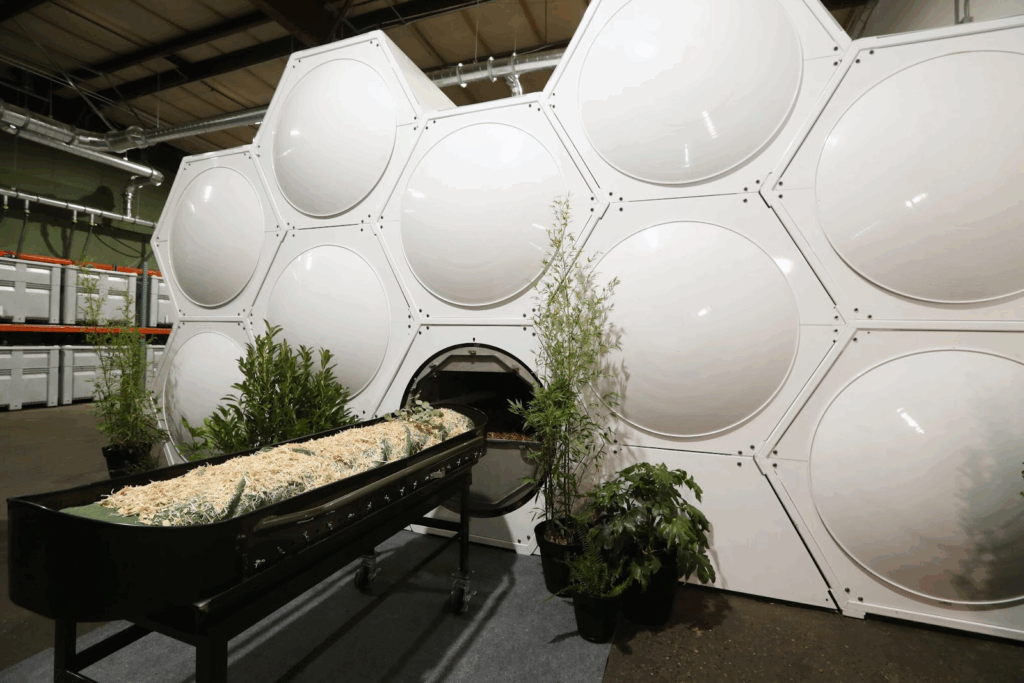
Recompose facility in Kent, Washington
Since Spade first introduced the concept of natural organic reduction, a number of other companies have begun to offer the option as well. Two of the more well-established in the U.S. are Earth, which calls its process “soil transformation” and offers services in Arizona, California, Nevada, New Mexico, Oregon and Washington, and Return Home, a Washington based company that offers the process, which it calls “terramation” to families across the continental United States.
Alternative No. 8. Plastination
Developed in 1977 by Dr. Gunther Von Hagens at the University of Heidelberg in Germany, plastination is a method of body preservation that involves extracting all bodily fluids and soluble fat from a cadaver and then using “vacuum-forced impregnation” to infuse the cells with a liquid polymer such as epoxy resin, polyester or silicone. It is a time-consuming, expensive, multi-step process that involves dissection of the body and subsequent repositioning of the plastinized tissues, followed by an extended period of “curing” or hardening. The finished products are unique, life-like specimens that are used for medical education and research or placed on display in one of several Body World exhibitions across Europe, Canada and the U.S.
Currently, plastination of human remains is performed on donated bodies in over 400 facilities worldwide. The body donation program is administered by the Institute for Plastination in Heidelberg, Germany, which has a roster of almost 20,000 body donors as of June 2019.
Alternative No. 9. Promession
Developed by a soil scientist Susanne Wiigh-Mäsak in 1997, promession is a form of final disposition that proposes to use liquid nitrogen and mechanical vibration to freeze the body and then turn it into fine particles much smaller than cremation ash. The concept has been widely adopted by a number of advocacy groups across the globe; however, it has not yet been used to dispose of human remains. The company founded by Wiigh-Mäsak, Promessa, went bankrupt in 2015 without ever building a promession facility, and Wiigh-Mäsak died from cancer in 2020, so it is unlikely that promession will be available in the near future.
Why Choose Funeral Alternatives to Burial and Cremation?
As people across the globe become more attuned to the harmful effects of human activity on the environment and the planet, they are seeking more sustainable ways to live their lives. Insofar as everyone living will eventually die, many forward-thinking individuals are beginning to explore innovative ways to dispose of the dead in more environmentally friendly ways. And while none of the methods mentioned above is perfect from an environmental standpoint, each of them offers substantial benefits over traditional burial and flame-based cremation.
Sources
“Why conventional burial harms the environment”. Milton Fields. https://miltonfieldsgeorgia.com/conventional-burial-harms-environment/
“Volunteer Locally”. HRSA. https://www.organdonor.gov/get-involved/volunteer
“MPRSA General Permits”. United States Environmental Protection Agency. https://www.epa.gov/marine-protection-permitting/mprsa-general-permits
“The Real Environmental Impact of Cremation”. American Cemetery & Cremation. https://www.kates-boylston.com/american-cemetery-and-cremation/the-real-environmental-impact-of-cremation/article_8dab7b60-406f-11ee-9b6b-e7b6ddd4dd6d.html#:~:text=According%20to%20the%20Natural%20Death,mercury%20vapor%20and%20other%20pollutants.