

Alternatives To Burial: Alkaline Hydrolysis
Jump ahead to these answers:
- Why is Alkaline Hydrolysis Called Green Cremation?
- Is alkaline hydrolysis more eco-friendly than cremation or burial?
- How Much Does Alkaline Hydrolysis Cost?
- Is Alkaline Hydrolysis Legal in Every State?
- How Is the Liquid Portion of a Person’s Remains Disposed of After Alkaline Hydrolysis?
Why is Alkaline Hydrolysis Called Green Cremation?
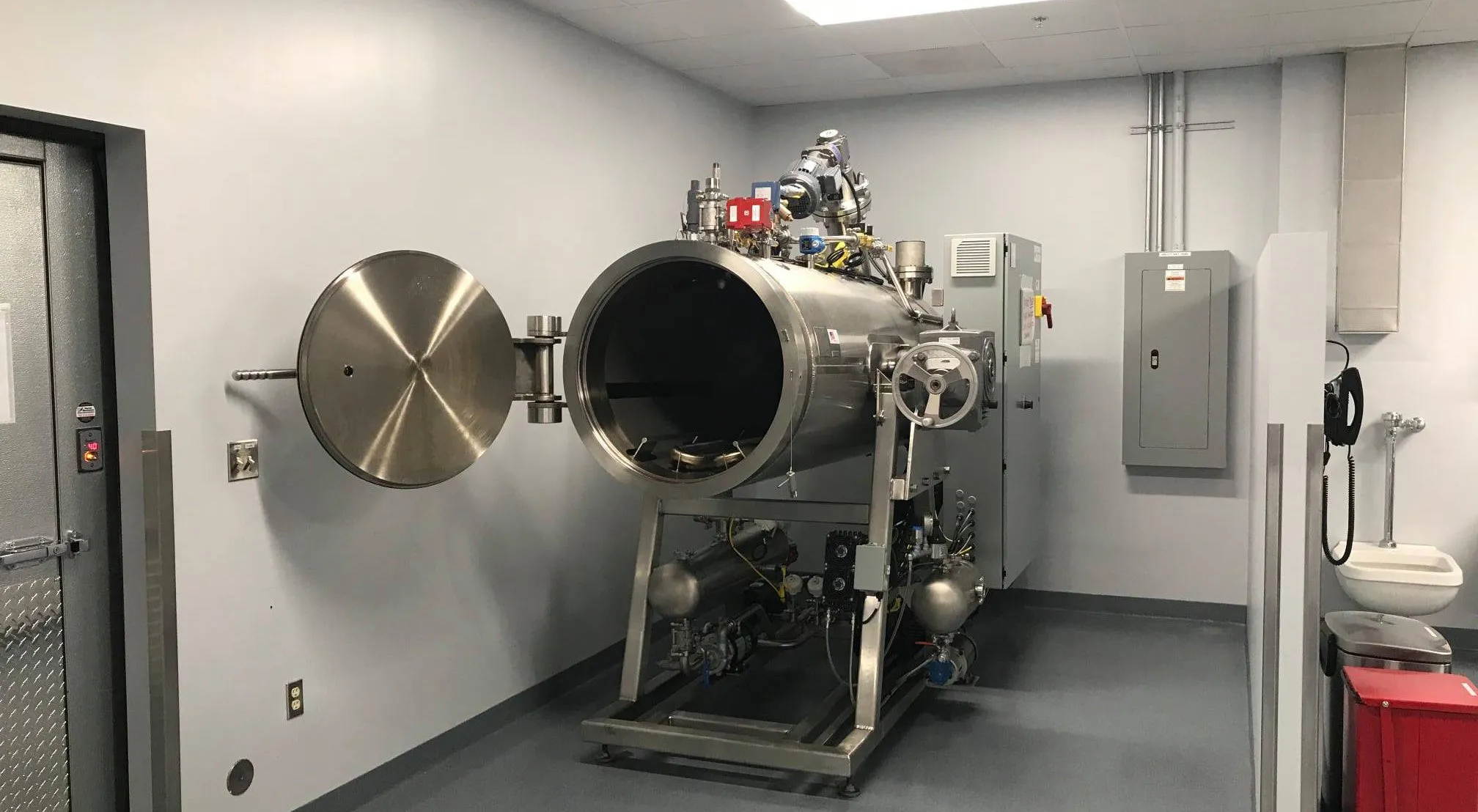
July 7th, 2025Alkaline hydrolysis (also known as “biocremation”, “green cremation”, or “aquamation”) is often marketed as an environmentally friendly alternative to traditional flame-based cremation. It is a chemical process involving water, potassium hydroxide, and heat to reduce the body to bone fragments and inert liquid. Similar to traditional cremation, ashes are produced in the final outcome.
Alkaline hydrolysis is generally safer for the environment than traditional flame cremation since it offers lower air emissions and no direct fossil fuel use. It may also reduce the use of formaldehyde, which might otherwise leach into the soil and groundwater. Traditional cremation is known to release mercury, carbon dioxide, and other harmful pollutants, which can worsen air pollution and contribute to climate change.
Since alkaline hydrolysis reduces some key environmental concerns, it is considered to be a promising “green” option, but it is not entirely without its own environmental impact. Although it is a flameless process, indirect emissions may occur depending on the energy source used for heating. It requires around 350 gallons of clean water per service, and the liquid effluent produced requires proper treatment before being released into wastewater in order to comply with environmental regulations. Ultimately, the sustainability of alkaline hydrolysis largely depends on associated water and energy use practices.
Sources
“FAQs”. Green Cremation. https://www.greencremation.com/faqs/faqs
“What is Alkaline Hydrolysis?” Verywell Health. https://www.verywellhealth.com/what-is-alkaline-hydrolysis-1131908
Is alkaline hydrolysis more eco-friendly than cremation or burial?
July 7th, 2025Proponents of alkaline hydrolysis point to its low environmental impact as one of its most attractive traits, and have marketed the technology as “green cremation” to highlight that claim. And the process does, in fact, use less energy than flame-based cremation and doesn’t emit any carbon dioxide into the atmosphere as flame cremation does. (According to some estimates, the total annual CO2 emissions from fire cremation in the U.S. is around 360,000 metric tons.) However, despite many claims to the contrary, there is little scientific evidence that either flame-based cremation, alkaline hydrolysis or natural burial is the more sustainable choice.
Take, for example, the process of alkaline hydrolysis. According to most sources in the industry, it has a 75% lower carbon footprint than flame-based cremation and offers the added benefit of avoiding the mercury emissions that occur when dental fillings are burned. However, according to Philip Olsen, an associate professor in the Department of Science, Technology and Society at Virginia Tech, the process of making the lye used in alkaline hydrolysis is extremely energy intensive, and, depending on the process used, may emit several hundred pounds of mercury into the atmosphere each year. And while alkaline hydrolysis requires no burial container, a body may be cremated in a plain cardboard container, the making of which has very little environmental impact at all.
Arguably, both flame-based cremation and alkaline hydrolysis offer environmental benefits over the typical North American funeral, in which an embalmed body is buried in a hardwood or metal casket inside a concrete burial liner in a cemetery with manicured, carefully tended lawns. What’s more, urban and suburban areas across the globe are simply running out of room to bury the dead. However, without a side-by-side, scientific comparison of the two options, it’s impossible to make a definitive statement about which of the two is better for the environment.
Sources
“The environmental toll of cremating the dead.” National Geographic. https://www.nationalgeographic.com/science/article/is-cremation-environmentally-friendly-heres-the-science
“Philip R. Olson.” Virginia Tech. https://liberalarts.vt.edu/departments-and-schools/department-of-science-technology-and-society/faculty/philip-olson.html
“Traditional burials are ruining the planet — here’s what we should do instead.” Business Insider. https://www.businessinsider.com/traditional-burials-are-ruining-the-planet-2016-4
How Much Does Alkaline Hydrolysis Cost?
July 7th, 2025Like all forms of final disposition, the cost of alkaline hydrolysis varies by location, provider and the kind of equipment used. As of early 2021, at The Natural Funeral in Lafayette, Colorado, the cost of direct alkaline hydrolysis is $4,995, which includes the return of the loved one’s ashes and essence and a simple biodegradable urn. The cost goes up to $6,295 if the family wishes to have the funeral home wash, anoint, and dress their loved one and transport the body to the alkaline hydrolysis facility. By contrast, central Florida’s Casket Store and Funeral Chapel charges $750 for direct alkaline hydrolysis, which includes the return of the person’s ashes and a simple urn. And at Bradshaw Funeral Homes in Minneapolis, Minnesota, the cost ranges from $2,395 for a simple direct alkaline hydrolysis to $3,995 for alkaline hydrolysis plus a memorial ceremony.
Unfortunately, since there are still very few service providers who offer alkaline hydrolysis in the U.S, there is little opportunity for consumers who want to shop around.
One of the biggest factors driving the cost of alkaline hydrolysis is the purchase price of the equipment. According to Mitch Shlensky of Bio-Response Solutions, the machines typically cost about $150,000 to $300,000 each, depending on the temperature the machine can reach. High-temperature, pressurized models are more expensive (about $250,000 in 2021) but complete the process in about 6–8 hours, versus 14–18 hours for a low-temperature, more affordable machine. Obviously, a quicker turnaround time allows the provider to handle a larger volume of deceased individuals, which should drive down costs. However, the process is still slow compared to flame-based cremation, which typically turns a body to ash in 2–3 hours or less. As a result, very few crematories and funeral homes have adopted the technology as of 2021.
It’s worth pointing out, however, that alkaline hydrolysis requires no casket, which offers cost-conscious consumers considerable savings over cremation, for which a burial container is required by law. In fact, the Funeral Consumer Alliance of Minnesota says that alkaline hydrolysis will only dissolve protein-based materials and has no effect on materials such as wicker, cotton and wood. For this reason, the body is typically wrapped in a leather, silk or wool shroud or a biodegradable plastic sheet.
Sources
The Natural Funeral. https://www.thenaturalfuneral.com/
Bradshaw Funeral. https://www.bradshawfuneral.com/our-green-cremation-services
BioResponse Solutions. https://bioresponsesolutions.com/
Funeral Consumer Alliance of Minnesota. http://fcaofmn.org/alkaline-hydrolysis-green-cremation.html
Is Alkaline Hydrolysis Legal in Every State?
July 7th, 2025According to the map supplied by the Cremation Association of North America, shown below, alkaline hydrolysis of human remains is currently legal in 19 states.
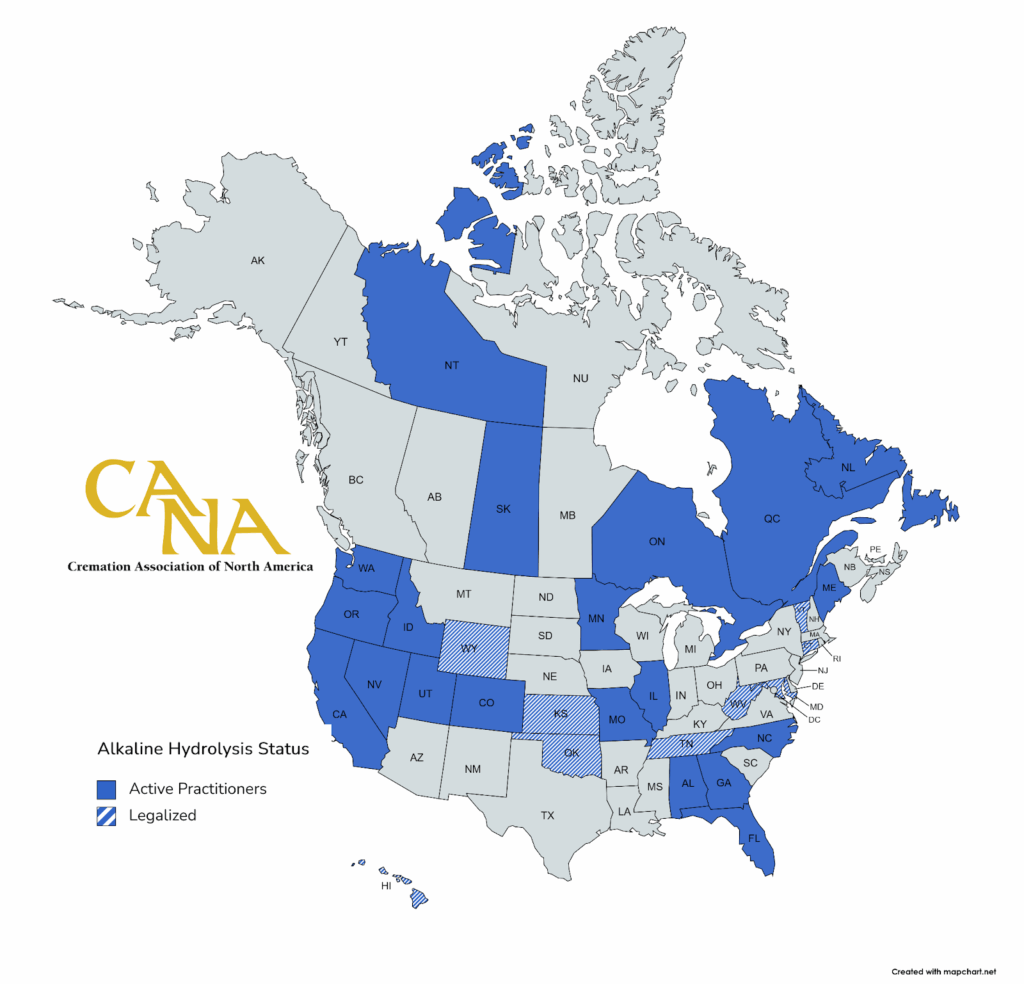
They include:
- Alabama
- California
- Colorado
- Florida
- Georgia
- Idaho
- Illinois
- Kansas
- Maine
- Maryland
- Minnesota
- Missouri
- Nevada
- North Carolina
- Oregon
- Utah
- Washington
- Wyoming
However, in many cases, it was made legal by changing the definition of cremation rather than by legalizing the process itself. According to Barbara Kemmis, the Executive Director of the Cremation Association of North America, these states broadened the meaning of cremation to include any “mechanical or thermal or other dissolution process that reduces human remains to bone fragments,” in order to allow alkaline hydrolysis to occur legally there. CANA also adopted that definition in 2013.
With that being said, CANA estimates that 1% of all cremations in North America are carried out through alkaline hydrolysis. And, according to a 2019 survey conducted by the National Funeral Directors Association, only 7.5% of those who responded were aware of alkaline hydrolysis. This could be a reflection of several issues:
- Alkaline hydrolysis is not widely available. As of this writing, facilities are available in only 15 states.
- Religious objections. A number of religious leaders have voiced objections to alkaline hydrolysis. For example, in 2008, the Catholic Conference of Ohio was successful in helping to defeat an effort to legalize the practice, saying, “Dissolving bodies in a vat of chemicals and pouring the resultant liquid down the drain is not a respectful way to dispose of human remains.” However, other Catholic leaders have deemed the practice “morally neutral.”
- The “ick” factor. Many people simply find the idea of dissolving a body in a vat of lye aesthetically repugnant. This is an issue of public perception, of course, and may dissipate with time. At one time, the public reacted the same way to the idea of FIRE CREMATION, which is now the most popular form of FINAL DISPOSITION in the U.S.
Sources
“What do you know about alkaline hydrolysis?” Cremation Association of North America. https://www.cremationassociation.org/blogpost/776820/313847/What-do-you-know-about-Alkaline-Hydrolysis?hhSearchTerms=%22alkaline+and+hydrolysis%22&terms=
How Is the Liquid Portion of a Person’s Remains Disposed of After Alkaline Hydrolysis?
July 7th, 2025As a rule, the liquid by-product of alkaline hydrolysis (called the effluent) is disposed of at a wastewater treatment center in the municipality where the process took place. According to John Ross, former executive director of the Cremation Association of America, “It’s very similar to the treatment of excess water from any (industrial) facility. In fact, it probably has less of a chemical signature than you would find (in liquids) coming out of most (industrial) plants.”
In order to ensure the safety of the water supply in places where alkaline hydrolysis is allowed, many municipalities require facilities to follow a stringent process established by state or local law. For example, California requires licensed alkaline hydrolysis facilities that do not have permission to dispose of the waste in the municipal water supply to transport the liquid to a “publicly owned wastewater treatment plant or licensed industrial anaerobic digestion facility or waste-to-energy or biomass facility” using a “state-licensed biomaterials handler.” Additionally, most jurisdictions require any fluid released into the sewer system to be at or below a certain pH level. Since the effluent is extremely alkaline, with a pH of about 11–14, some areas require that the effluent be treated with carbon dioxide to achieve a lower pH before it is released into the environment. With that said, a new device developed by Ed Gazvoda creates an effluent with a neutral pH.
Further, in at least one location in the U.S., the effluent is returned to the family if they so choose. Natural Funerals in Lafayette, Colorado, allows families to take home all or some of the approximately 25 gallons of their loved one’s “essence,” to use in their garden or another location to fertilize plants. If loved ones choose not to take home the effluent, it is donated to a local nursery or vendor to be used as fertilizer rather than being flushed down the drain.
Sources
“Alkaline Hydrolysis: Water Cremation and the “Ick Factor”. Confessions of a Funeral Director. https://www.calebwilde.com/2014/07/alkaline-hydrolysis-water-cremation-and-the-ick-factor/
California Legislative Information. https://leginfo.legislature.ca.gov/faces/billTextClient.xhtml?bill_id=201720180AB967
The Natural Funeral. https://www.thenaturalfuneral.com/