“Hand to Earth” by Andy Goldsworthy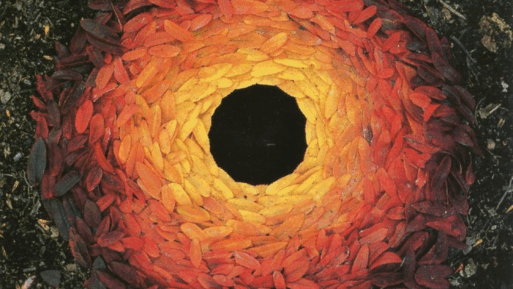
Rowan Leaves Laid Around Hole, Yorkshire Sculpture Park, 1987
Photo Credit: Moss & Fog
If you’ve ever seen precariously balanced rock piles, also called cairns, while hiking or at the beach, then you can begin to imagine the artwork that has made Andy Goldsworthy notable. However, his art — which uses objects found in nature — goes well beyond piles of pebbles. Using a wide range of materials like sticks, flowers, snow, mud and stones, his sculptures are often ephemeral, much like nature itself.
The images in “Hand to Earth,” originally published in 1990 and tracing about 15 years of his artistic journey, reveal some of his process in creating these sculptures. Illustrated with over 200 of the artist’s own photographs and sketches of his sculptures, along with documentary photos of Goldsworthy at work, readers can see why he has captured the attention of art enthusiasts around the world.
The text accompanying these images provides valuable insight into Goldsworthy’s inspirations and methodology, and might even inspire readers to try their own hands at creating art inspired by the impermanence of nature. However, casual readers might find they get more satisfaction out of “Hand to Earth” just admiring the pictures.
Goldsworthy’s Artistic Process
Often using only his bare hands, teeth, saliva and found tools, Goldsworthy shows an impressive amount of innovation when creating his site-specific sculptures.
“I want an intimate, physical involvement with the earth,” he writes in the prologue. “I must touch. … I take nothing out with me in the way of tools, glue, or rope, preferring to explore the natural bonds and tensions that exist within the earth. … Each work is a discovery.”
Inspired by whatever he found that day, his pieces over the years share similar themes despite being crafted from disparate materials. These themes can be attributed to Goldsworthy’s artistic eye, and reflect and contrast the patterns in nature.
Readers perusing the photographs in “Hand to Earth” will be able to see how Goldsworthy’s art progressed. It becomes apparent through each chapter that his method involves seeking out something particular, and then elaborating on it until he is satisfied. He loved using bright red poppy petals, for example, licked and stuck together, then pasted to objects to create eye-catching lines that would cut through an otherwise pastoral scene, or wrapped around a stone amid boulders made dull and dreary in contrast.

Poppy petals wrapped around a boulder held with water. The book is filled
with inspiring mediative art therapy possibilities.
Photo Credit: Back Jacket of Hand to Earth
Although his style is instantly recognizable to people familiar with his work, there is remarkable variation to his pieces as well, even when he uses one particular medium. For example, his “leafworks” took on a myriad of forms. Some pieces were referred to as “plates,” which were leaves in contrasting colors arranged in shapes on the ground, forming linear patterns and gorgeous, circular mandalas. His “shields” were made by “sewing” leaves together using their own stems to make a curtain of semitranslucent color that he would hang from tree branches.

Sycamore leaves stitched together with stalks hung from a tree. This spurs the idea of creating a unique memorial project on a bright fall day.
Photo Credit: Hand to Earth
Later projects included incredible three-dimensional objects also made out of leaves, like impressively symmetrical cubes, or sweet chestnut leaves woven together to form a column of cones stacked upon each other.
“Hand to Earth” Is Dated, But Still Beautiful
Originally published in 1990 to accompany a major exhibition of Goldsworthy’s work at Leeds City Art Gallery in Yorkshire, England, “Hand to Earth” would greatly benefit from a modern makeover. Although the photographs included are beautiful, one finds oneself wondering whether it would be possible to publish them in higher definition with today’s technology.
The substantial amount of text that accompanies the images — critical and descriptive essays from various enthusiasts, quotations from the artist, and three interviews — almost seems extraneous when included side by side with Goldsworthy’s images. Although much of it adds interesting insight about his process and intentions, the pseudo-intellectual prose is almost at conflict with the relative simplicity of his sculptures.
For example, Goldworthy wrote a brief essay as an introduction for “Hand to Earth” about the role photography plays in his work: “[The photographs] are not the purpose but the result of my art. … The photograph does not need to shrivel and fall to the ground for change to be part of purpose. It is an outdoor experience expressed in an indoor place which uses the conventions of that place to keep its meaning clear. … If a photograph represents the work alive, then work brought indoors becomes its husk.”
“Hand to Earth” as a Meditative Guide
Perhaps the best use for “Hand to Earth” (other than as a beautiful coffee-table tome) is as a practical guide and inspiration for creating your own found-object artwork. Goldsworthy says in the book that his art was for him highly meditative — the process was as important as the final vision. As he explained to art historian Fumio Nanjo in 1987: “I have an art that teaches me very important things about nature, my nature, the land and my relationship to it … something through which I try to understand the processes of growth and decay, of life in nature. Although it is often a practical and physical art, it is also an intensely spiritual affair that I have with nature.”
Following his example could prove to be a helpful method for coping with grief and loss.

Goldsworthy’s dark dry sand drawings. One can easily imagine this for a beach celebration of life, be it reflecting a loved one’s personality or as a group activity.
Photo Credit: Hand to Earth
Research has shown art therapy to be a helpful practice; following Goldsworthy’s method would encourage a mindful state that could be immensely satisfying. Not only would it require a walk through nature — which is almost always healing — but it could be a constructive way to process some complex emotions. As one artist inspired by Goldsworthy wrote in 2020, “Every failure in the form of collapsing rock or melting ice is a way Goldsworthy finds reconnection with nature and with himself. Each collapse requires a moment for a few deep breaths, but it provides a lesson about limits, physicality and our relationship with creation.”
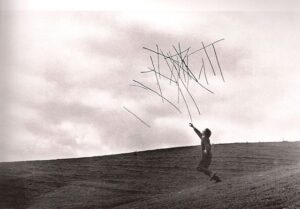
Hazel stick throws. This series suggest the idea of tossing natural elements along with cremation ashes as an artistic gesture or a profound statement of a life lived.
Photo Credit: Hand to Earth
Outside of creating your own art as therapy, Goldsworthy’s artwork in “Hand to Earth” is also a reminder that nothing lasts forever. Loss is built into the cycles of life, which is something the artist contemplated often. He worked with nature and within nature; after photographing his work he would release it to the mercy of time and the elements, until its inevitable erosion.
As metaphors for our own life cycle, Goldworthy’s artwork encourages us to enjoy the fleeting temporal nature of existence, and embrace its eventual ending. As he writes: “I used to say I will make no more holes. Now I know I will always make them. I am drawn to them with the same urge I have to look over a cliff edge. It is possible that the last work I make will be a hole.”





 Final Messages of the Dying
 Will I Die in Pain?