Daughter Stayed at Her Parents’ Sides Before and After Deaths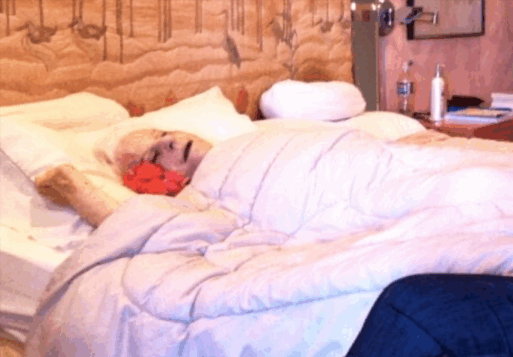
This is Rachel’s story, as told in her own words, about navigating and honoring the deaths of her beloved parents — what she refers to now as a “deeply satisfying experience.” Our “Opening Our Hearts” stories are based on people’s real-life experiences with grief and loss. By sharing these experiences, we hope to help our readers feel less alone in their grief, and ultimately aid them in their healing.
My mom
Estelle was a stunner, an accomplished designer and businesswoman born in 1914 who lived life with gusto right to the end. She was on oxygen for a failing heart, but Estelle had theater tickets in her purse when she passed and was busy planning her 98th birthday party just three weeks away.
My parents had been happily married 64 years. Dad had gotten up early to make his coffee and toast as was his routine; Mom typically slept in and had breakfast later. But when she hadn’t come into the kitchen by 10 a.m., he went to check on her. He found her still in bed, motionless and cold to the touch. He called me.
Living just 3 miles away, I arrived quickly to comfort him and see for myself. There she was, hand resting by her head with a slight smile on her face. Instinctively, I dotted her temples with her favorite perfume then went to their balcony and picked a bright red flower from the planter box, which I tucked in her hair behind her ear (looking good was really important to Mom).
Then I started making phone calls — not to the county coroner but to those who loved her.
My boyfriend went to pick up my sons from school and for the next five hours or so, my siblings and I, her grandchildren, dear friends and adoring husband surrounded Estelle in her bed. We reminisced about the wonderful ways she loved us and about her legacy. It was a most tender time of coming together, no rush, lots of questions from my young sons, which helped them and all of us process our loss.
The flower’s scent and perfume enveloped anyone who leaned in to kiss her or stroke her face. Mom looked serenely beautiful in repose — we so enjoyed this time with her, telling stories, crying and comforting each other. It was 4 p.m. by the time I finally called 911.
The EMS staff who arrived to confirm she was dead chided me for not calling them sooner— like immediately upon discovering her body in bed. They said that time between discovery of a death and calling to report it makes authorities suspicious because it gives someone time to cover up signs of foul play.
“Foul play!” I laughed. “Look around the room, feel the love! Does this look like foul play?”
I told the EMS workers that we had wanted to savor our time with Mom and say our goodbyes at our own pace, and that I wouldn’t have traded these last few hours with her for anything. Respectfully, they said nothing more, completed the paperwork for her death certificate and left.
As per Mom’s pre-planning, I called Neptune Society and they collected her body.
Three weeks later, on the date Estelle had planned to hold her 98th birthday party, we held a lively memorial with friends, music and stories to celebrate her amazing life.
My dad
Leonard was a stiff-upper-lip, Greatest Generation guy who kept a tight lid on his emotions. As a dad, he was affectionate and attentive, but he was never one for small talk.
After my parents sold the business they had successfully run together for decades, Len was bereft and rudderless as he tried to figure out what to do with the rest of his life.
Of course, Dad didn’t let on about this when I visited from college. I learned about his foundering from my mom, in whom he confided and found solace. When my visit was over, Dad helped carry my bags into their building’s elevator. The two of us were alone in that mirrored box as it inched its way down to the parking garage. I felt his sadness. Uncomfortable with the silence, I ask Dad if he needed anything. He burst into tears and sobbed: “Just be there for me.
Seeing my dad so vulnerable was at once terrifying and special. I hugged him tightly and promised, “I’ll be there for you, Dad.” By the third floor, he’d wiped away his tears and composed himself. When the elevator door opened onto the garage, he was his stiff-upper-lip self again, helping me load my car and sending me off with a hug. I had no idea what “being there” for him meant — what it would entail — but I knew I’d step up when that time came … as he had for me all my life.
Dad went on to create a satisfying third act with Mom in retirement. His zest for life ebbed quite slowly but by age 95 he was definitely more grumpy and sleepy.
When Mom passed in her sleep, he turned gloomy and adamant about wanting to die. He wasn’t in pain but very uncomfortable (from an enlarged prostate that put pressure on his bladder). I moved Dad into my home, my bedroom, my bed, while I slept on a cot in my son’s room.
Although having an enlarged prostate was not a terminal illness, we managed to get Dad on hospice, which brought wonderful hospice nurse Gilma into our lives. Dad grew more ornery, though we still had tender moments going over old photos to get him reminiscing. Sometimes we just sat together in silence as I stroked his back.
Dad’s refrain of “Just let it be over. I want to die,” became more frequent. One spring day as I was preparing his lunch, he asked me point blank to help him die.
“Dad, I can’t do that. It’s not fair to put me in that position.” But I knew he’d ask again. When he did a few days later, I told him about VSED (voluntarily stopping eating and drinking) — my friend with ALS had done that — and that if and when he made that decision, he just needed to give me a clear sign and I’d make sure he felt no pain. I’d be there for him every step of the way.
He looked at me with his tired blue eyes and nodded. I knew he understood. Then he went back to sipping his soup.
Dad rallied for his 99th birthday party in May 2012, regaling gathered kin and friends with his stories and soaking in their love and admiration.
After that milestone, Len grew morose. His doctor said his prostate would continue expanding until it blocked his urinary system. The hospice nurse gave me a bottle of morphine for deep sleep so the pressure on his bladder wouldn’t wake him when he slept.
One early Saturday morning in November, Dad had a mini-stroke (a TIA) while I was tending to him in the bathroom. He froze in place, eyes vacant, stiff but still able to walk. Once I got him settled back in bed, I went to the kitchen to make his usual breakfast — black coffee and buttered toast — and returned to the bedroom with it on a tray. With one hand, Dad waved it away. I set the tray down on the nightstand. His deep blue eyes looked deliberately into mine and lingered there. Then he closed his eyes to rest.
That was his sign.
Dad never touched his breakfast or asked for another bite of food. With a dropper of morphine throughout that day, that evening, the next morning, and the days following, I helped him remain in a deep sleep. Family members, friends and the hospice nurse came and went. I was always there for him. When he came briefly to consciousness, I soothed his dry mouth with a wet cloth, put Vaseline on his lips. Dad never expressed discomfort or asked for food or water. If he had, I would have given it to him.
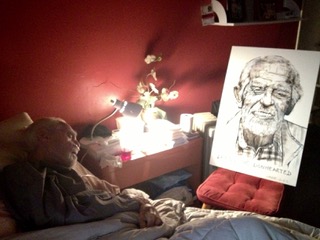
Around dawn on a Wednesday, Dad came to momentarily. It was the perfect chance to show him the portrait his artist son-in-law had painted of him called “Lenny the Lionhearted.” Dad chuckled: “It’s like I’m looking in the mirror.” I gave him more morphine drops.
“I love you, Dad.”
“I love you, too. Thank you,” he said and went back under.
Those were our last words. On day seven, Dad passed. It’s awkward — that absolute final goodbye. How do you honor it; what do you do? I followed the Neptune Society team to the carport as they wheeled him out on a gurney. And even though I’d never served in the military, I saluted and remained still while they loaded him into the van. Right at that moment, my neighbor Jimmy, a Vietnam vet, was walking by with his basset hound named The General. Jimmy saw me in the carport in my bathrobe, saluting the body bag. Jimmy stopped and saluted, too, with The General by his side. We remained like that until the van drove off out of sight — a humble little honor guard for a life well lived and a promise kept.





 Final Messages of the Dying
 Will I Die in Pain?