Examining the Archaeology of the Undead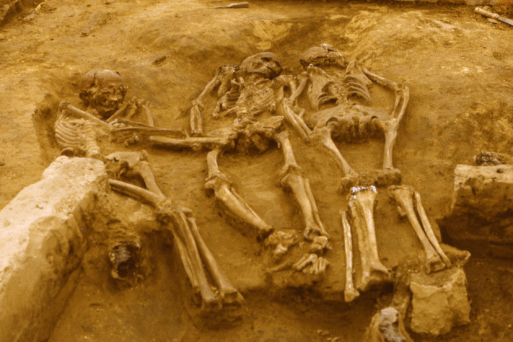
Deviant burial in Czech Republic.
Image courtesy of Mittnik A., Wang C-C., Svoboda J., Krause J.
Countless books, films and oral traditions stretching back through the farthest reaches of recorded thought have conjured images of reanimated corpses rising from the earth to extract their lost lifeforce from those who survived them. It’s a notion that startles us from childhood nightmares, strolls the streets on Halloween, and rakes in millions at the box office. What if this archetypal adversary isn’t a product of modern creativity, but an ancient ancestral memory of fears that arose long before our capacity to catalogue them?
A new essay in Aeon by archaeologist and scientist Rebecca Batley explores scientific evidence suggesting that our fear, not of death but the dead themselves, may be traced back as far as 28,000 years.
In 1985, those carrying out an irrigation project on the Dyje river in modern-day Czech Republic uncovered a grave from the Upper Paleolithic era (38,000 to 10,000 BCE) containing the skeletons of three boys. Their skulls were coated in red ochre, and they were covered in charcoal from burnt wood that had been laid over them.
Writes Batley, “The middle boy, named DV 15, was partially buried beneath the other two and showed severe pathological changes indicative of disease. To the right, DV 14 had been buried on his belly. To the left, DV 13 had been laid on his back with his outstretched hands reaching towards the pubic region of DV 15, which had been covered in red ochre.” Analysis shows that DV15 most likely suffered from a condition that causes abnormal skeletal and cartilage development. The other two boys, DV 13 and DV 14, however, appeared to be healthy.
There’s no consensus as to why these boys were interred in what archaeologists term a “deviant” burial, but this is the earliest known example of the practice in which a body was treated differently than the customs of their society, in this case painted blood red and pinned down beneath wood.
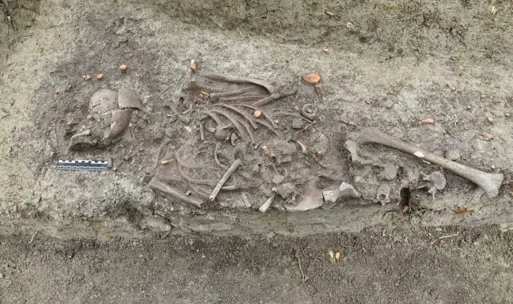
Skeleton unearthed in Poland.
Courtesy the Lublin Region Conservator of Monuments
Quoting British archaeologist Paul Pettitt, Batley continues, “This is an example of ‘ritual containment’. Was the use of wood, as well as the position of the two boys
on either side – one looking up, the other looking down – intended to prevent the ‘diseased’ individual in the middle from returning?” Drawing parallels between this early find and evidence of subsequent burial practices, Batley seems to think so, and makes a compelling if cautious case.
Progressing through examinations of Neolithic sites in Cyprus and Iron Age burials in Europe, Batley explores a pattern of deviant burials in which bodies — some showing, for instance, possible malformation or illness — were pinned down under large rocks or bound with rope. The essay plots a map of mankind’s relationship with the dead from what are possibly the earliest examples of burial of hominids to our modern preoccupation with the undead. Incorporating references to Homer’s “The Odyssey” and sociological evidence suggesting a correlation between outbreaks of disease and abnormal interments along the way, Batley composes a strangely familiar yet persistently mysterious landscape of what may well be one of humanity’s oldest fears.





 Final Messages of the Dying
 Will I Die in Pain?