National Cremation Growth Rate Is Slowing
 In its 2025 Annual Statistics Report, the Cremation Association of North America (CANA) confirms that after decades of rapid growth in the United States, the national cremation growth rate is starting to slow, after reaching 61.8% in 2024.
The organization predicts that by 2029, the cremation rate in the U.S. will be 67.9%. And, as reported in a news release in Connecting Directors, a funeral industry publication, “By 2033, CANA research predicts the cremation rate in all states will reach or exceed 50%, with the national rate surpassing 70%.”
For over a century, CANA has tracked the rising cremation rate across the country. In the past 25 years, CANA has also gathered data at the state and local levels. Its research has shown a steady and predictable increase in the number of people choosing cremation over traditional burial: The cremation rate grew from 5% in 1972 to 60.6% in 2023, increasing at a steady pace even through recessions and the COVID pandemic.
Predictions for the U.S. are based in part on the fact that the U.S. seems to be following a similar growth trajectory to that of Canada, but 15 years behind.
What Does the Shift in Cremation Rates Mean?
According to the National Funeral Directors Association in a 2024 report on cremation rates, “Families’ increased preference for cremation is influenced by cost considerations, environmental concerns, fewer religious prohibitions and a desire for simpler funeral ceremonies.”
Other forms of disposition, including alkaline hydrolysis (AH, also known as water cremation) and natural organic reduction (NOR, also known as human composting) do not seem to affect the pace of change in the growth in the cremation rate. As reported in Connecting Directors, “CANA’s estimated data shows that AH and NOR processes remain a negligible factor at this point. They account for 0.3% in states where the methods are practiced and 0.1% nationally.”
To those in the death care industry, an early decline in the U.S.’ rate of cremation could mean nothing more than that the initial exponential phase of growth is ending. It could also signal a shift in the dynamics of cremation rate growth, indicating a need for new innovations, new markets or adaptations to meet demands.
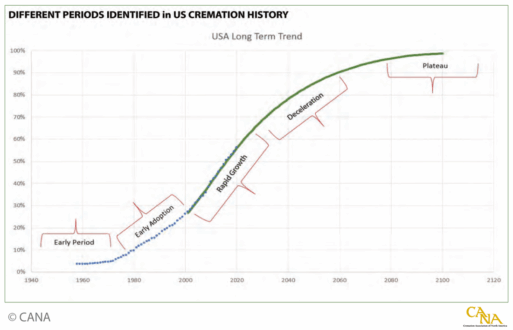
Cremation Growth Rate in the United States over time
Credit: CANA
Why Track Cremation Rate Trends?
The people most directly affected by these statistics are funeral home directors and people who make their living in the death care industry. But aside from being a useful tool for small business owners, this data can be indicative of larger societal trends in our country.
Analyzing the data surrounding cremations can offer a glimpse into broader societal and economic factors that influence a family’s decision.





 Final Messages of the Dying
 Will I Die in Pain?