“Death Canoe” Poetry Review: Grief Is a Vessel Carried Away by a Current
In the poem, grief becomes a current that keeps on transforming. Credit: Andrew Draper on Unsplash
Grief flows from Maggie Nelson in sensuous prose meshed up with time passing in blood. Take the first lines of “Death Canoe”:
“Surprised by blood passing, a large clot for morning, surprised later on in the day by the ice cold commitment to dispersal in which I am drowning.”
There’s nothing neat about grief.
This poem from one of the most celebrated writers of her generation is included in her 2018 collection, “The Latest Winter.” The anthology “charts intimate landscapes,” publisher Bloomsbury wrote.
As Nelson lived in New York before and after 9/11, one can imagine that this work comes out of a time of immense loss and grieving.
Time passes, life passes, grief passes. In that vein, through which our blood flows, the title “Death Canoe” evokes a vessel carried away by this current — grief. There’s a yearning driving these lines.
“I’m after something,” she writes.
Grief intangible. It’s universal and deeply human, so there’s a connection in it.
The pitch of a nameless stream where we dumped pitted bones, a part of everybody’s story, and now a part of mine. I saved a handful without knowing why. And now I’m afraid, will they continue to decay? Have I ill-treated them, left them like wine in the sun? You know, I would drink it anyway, the curdle, the pitted bones in fresh water. After you slice up the greens, and the reds, and all the fancy mushrooms, then we say grace and commence.
Grief flows into a cup of water that these bones soaked in, or life. She’s holding on to it as she can’t let it go, at a dinner table. But she must, communing with it. She says grace because life, food, death, and grief is sacred, and the next part of the day begins, the end. It’s the sacredness in this poem that resonates as so true and meaningful.
And for a moment she forgets. She creates the sensation of acceleration in the next stanza — of fleeting moments:
The dupes don’t mind a good night to die, a pitch black ride through the Indian countryside, the driver slapping on and off his lights, freezing the women with bundles along a road, or a descent down a mountain in Spain, straddling sangria, and Patricia, and two wide dusty lanes.
This captures the reality of grief, of being all right in one moment, wanting to take off, and even forgetting the inevitability of death in an image that sounds as if it’s deeply personal to her,, that includes others, surprisingly, and even a funny memory in Spain with sangria. Grief is like that.
In the end, she mysteriously says:
“I want you to know I conducted a war for this, a war to lose my life. And I lost it. I lost it. I reduced it to a death canoe, and it still came out as life.”
A beautiful if not… puzzling end.
Nelson reads her poem aloud here.
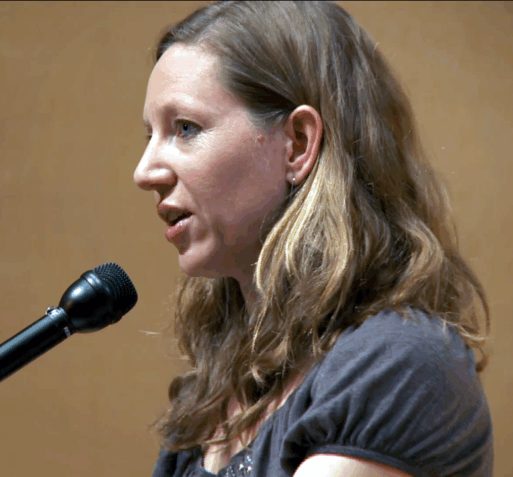
Maggie Nelson is one of the most revered writers of her time. Credit: San Francisco Public Library Wikimedia





 Final Messages of the Dying
 Will I Die in Pain?