“Ordinary People” Movie Review: Redford Directorial Debut Explores Coping With Loss
Official poster for “Ordinary People,” directed by Robert Redford.
In Robert Redford’s 1980 directorial debut, a wealthy family deals with coping with loss as they struggle with the death of the oldest son, Buck Jarrett. “Ordinary People” explores how grief can affect people differently, as well as how losing a family member can reveal what truly happens behind closed doors. It remains an intriguing and heartfelt study of the importance of acknowledging grief.
Through a star-studded cast including Mary Tyler Moore, Donald Sutherland, Timothy Hutton and Judd Hirsch, “Ordinary People” introduces what appears to be a successful and happy family.
But looks deceive.
The first crack viewers see is through the family’s surviving son, Conrad Jarrett (Hutton). He struggles with nightmares, socializing and school. And we learn that he has recently attempted suicide after his brother dies in a boating accident.
Conrad begins to see a psychiatrist, much to his father’s relief. The father, Calvin Jarrett (Sutherland), is gentle and understanding, but he does not directly address Buck’s death unless prompted. Throughout the film, flashbacks of Buck’s death and Conrad’s suicide attempt plague Calvin, but he rarely confronts these emotions.
Anguish, Avoidance: Different Reactions to Death
Moore delivers a chilling and memorable performance as Beth Jarrett, Calvin’s wife and Conrad’s mother. Beth also has trouble directly confronting the death of Buck, but unlike Calvin, she reacts with hostility when Buck is mentioned. She prizes above all how the family appears, trying to conceal from friends and family the grief they all feel.
Conrad and Beth exchange heated words throughout the film. Conrad’s memories as flashbacks show the viewer that Beth appears to have been much warmer toward Buck, confirming his fears that Buck was her favorite.
As “Ordinary People” progresses, Conrad grows more comfortable with his psychiatrist, Dr. Tyrone Berger (Hirsch), who gets Conrad to open up and reveal his grief, survivor’s guilt and symptoms of post-traumatic stress disorder.
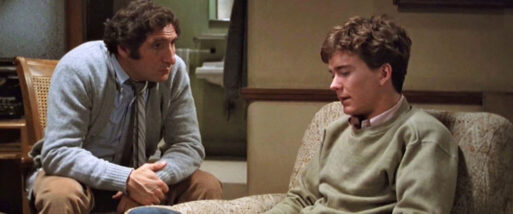
Dr. Berger (left) and Conrad (right) during their counseling session in Redford’s “Ordinary People.”
Dr. Berger helps the boy come to terms with the guilt he feels not only for his brother’s death but his parents’ fighting and his mother’s resentment.
Meanwhile, Beth and Calvin’s marriage is increasingly strained by their divergent approaches to Buck’s death and Conrad’s mental health: Beth continues to repress her internal anguish while Calvin prefers a more honest approach.
“Our son’s funeral, and you were worried about what I wore”
Indeed, Calvin confronts his wife’s seeming indifference with a memorable line: “Because I’ve always wondered, in some needling way, what it mattered what I wore. I was crazy that day. We were going to our son’s funeral, and you were worried about what I wore on my feet. I’m sure it sounds like nothing to you, but it stuck with me.”
Ultimately, Beth and Calvin can’t find common ground. Beth remains in a cold state of denial, shedding tears only when she realizes that her husband can’t continue the marriage.
As Calvin says tearfully, “We would have been all right if there hadn’t been any … mess. But you can’t handle mess. You need everything neat and easy. I don’t know. Maybe you can’t love anybody. It was so much Buck. When Buck died, it was as if you buried all your love with him, and I don’t understand that. I just don’t know, I don’t. … Maybe it wasn’t even Buck. Maybe it was just you.”
He goes on: “Maybe, finally, it was the best of you that you buried. But whatever it was … I don’t know who you are. And I don’t know what we’ve been playing at. So I was crying. Because I don’t know if I love you anymore. And I don’t know what I’m going to do without that.”
Losing a child affects marriages
The scene and the film are anguishing reminders of how the loss of a child can result in marital problems.
Director Redford’s “Ordinary People” can deliver a powerful message to those coping with the loss of a family member. It shows the raw and often unpleasant emotions that come with death and trauma. Those coping with loss who choose to watch might be helped: seeing difficult emotions felt through the characters can often feel cathartic. However, it’s also a heartbreakingly realistic story that doesn’t have an entirely happy ending, which may feel too soon for those with recent losses.





 Final Messages of the Dying
 Will I Die in Pain?