Mike Egan, a Visual Artist and Funeral Director, Tackles the Poetry and Reality of Death Through Art
As an artist and funeral director, Mike Egan has a unique perspective on death.
image credit: Mike Egan
First inspired by the oeuvre of Jean-Michel Basquiat, the tattooed Pittsburgh native depicts death as colorful and graphic because his work is really about life — death being inseparable from it — and a catalyst to live it fully.
As Egan states on his website, “I always like to remind myself that death is coming for me and that life is for living and doing what I love.”
His career as an artist began in unusual circumstances, as he searched for permanence career-wise, paradoxically even, after the tragedy of 9/11, which left him feeling unsafe and insecure. He turned to death, specifically funeral directing and embalming, as he would never be out of work.
Egan knew he was going to end up an artist, he told Ohio Magazine, even if he didn’t know exactly the steps he was going to take to get there. He began where life ends (depending on one’s point of view).
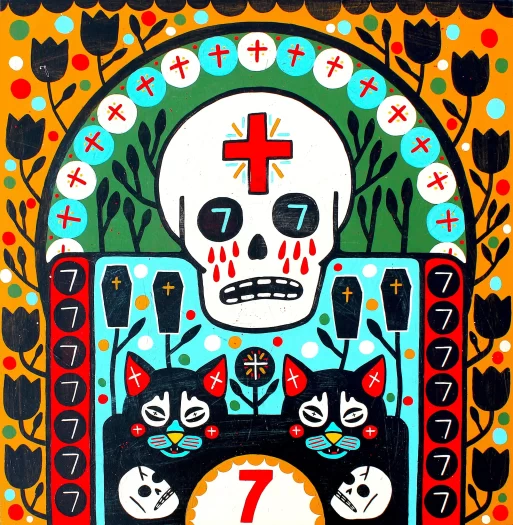
Title: “Death with Two Cats”
Skulls are a frequent motif in artist Mike Egan’s bold, colorful paintings
about death.
image credit: Mike Egan
Dealing with the matter of death directly —corpses— he was devoted to his work, reflecting his deep respect for the dead; he had to be on call 24 hours a day, four days a week. He accompanied about 1,000 bodies to their graves, all the while giving birth to an artistic vision. Egan breathed new life into a visual world that also touches upon the macabre, the Halloween-esque. His interest in American & prison-style tattooing is represented in “bold lines and dark imagery,” he describes on his website.
Soon, his work caught on, attracting interest and acquisitions for its inherent “positivity,” as noted in Ohio Magazine by Doug Helmick, who directed a short documentary entitled “Death: The Life of Mike Egan”. His perspective on death could be used as “motivation to live your life,” according to another artist and fan of Egan’s work.
“I like this ghostly thing that comes up from underneath,” continues Egan, as he traces skulls and cats from cutouts and proceeds to sketch on canvas or wood before he applies paint. If he doesn’t like what he paints, he paints over it. He then draws out even what he doesn’t like with sandpaper, which is poetic as an act of surfacing and erasure, and he does so perhaps to evoke what haunts us, what we can’t change, what we leave behind, but that meaning is up to us viewers to make.
As the end of 2025 rapidly approaches, 2,000 paintings later, Egan remains in a state of evolution, now turning to “the tiny deaths” we experience throughout our lives: the little ends, the moments that change us.
He isn’t seeking to resurrect the past but, as he concludes in Ohio Magazine, help people find closure, so they can keep living their lives. And, as is often the case with artists, their life might meet their work in increasingly resonant ways. He plans, at the end of his own life, to harken back to an ancient tradition by dismantling the panels of his coffin and selling them as collector’s items. Artwork.
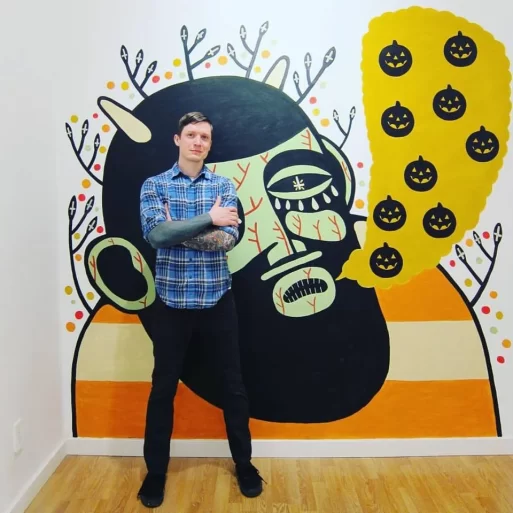
A mural Mike Egan painted in Portland, OR.
Credit: Mike Egan
Famously, “The Tomb of the Diver,” is a seminal and deeply moving depiction of a nude man diving into a pool of water, a true fresco painted onto the ceiling of a tomb and unearthed in the ancient Greek city of Paestum, Italy in 1968. The surrounding walls of the tomb, also on display at the local museum, were painted with scenes of banqueting, celebrating life, even after death — the real plunge into the unknown. This striking ancient imagery evokes a timeless message echoed thousands of years later in Egan’s work: take the plunge in life.
Check out his website for more information about Mike Egan’s life and death-centric artwork.





 Final Messages of the Dying
 Will I Die in Pain?