Revisiting The American Way of Death: Jessica Mitford’s Exposé of the Funeral Industry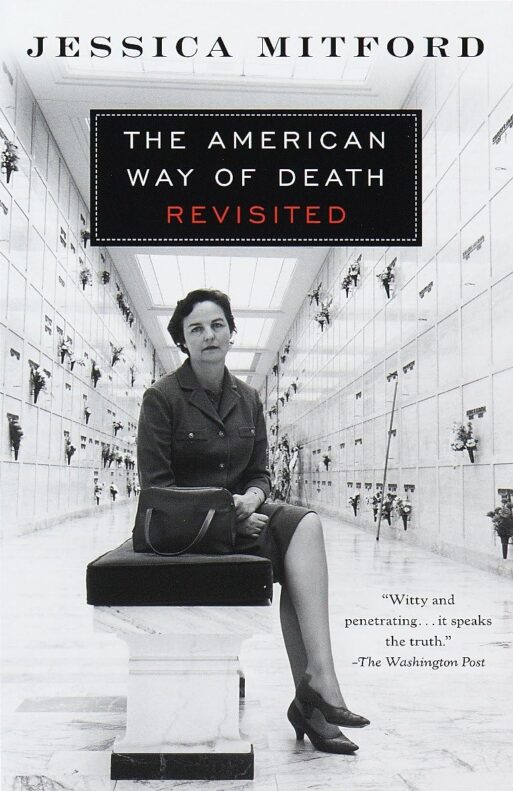
Gleefully, Jessica Mitford exposes the funeral industry in The American Way of Death Revisited, a smart, biting work of book-length reportage. First published in 1963, she updated the text in 1996 shortly before her death, leaving readers with a final chapter on the growing movement to reclaim the care and burial of one’s own dead, followed by a state-by-state directory of nonprofit funeral and memorial societies.
Both grave and funny, the book became a runaway bestseller and even helped spur legislation designed to protect grieving families from exploitation by what Mitford famously called “the dismal trade.”
She hilariously rips apart the industry with a biting, intelligent analysis of how funeral homes and undertakers exploit people’s fear and grief to steadily inflate the cost of funerals. In 1998, the average funeral cost about $7,800 — roughly $15,500 today. In the 1960s, and even as late as the 1990s, a funeral could cost as much as a house or an automobile.
In a chapter titled “The Artifacts,” Mitford recounts a conversation with a funeral director.
“Then you’ve got a slumber room tied up for three days or more,” the director explains. “ow much would it cost you to stay in a good motel for three days?”
“Motels for the dead!” Mitford exclaims. “A swimming pool and TV are the only missing features.”
It’s a strange, darkly funny note: funeral homes carefully design the experience to encourage people to spend extraordinary sums on a funeral. The industry even had lobbyists in Washington, a telling indicator of its power and influence.
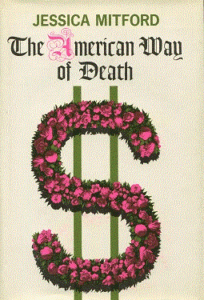
The original 1963 cover of the national best seller.
When you think about today’s AI “grief ghosts” and the recent waves of media controversy around them — particularly the concern that they exploit people’s loss — the parallel becomes clear. This is essentially what the funeral industry has long done, selling the idea that if you actually view the dead, it will help you therapeutically process your grief. Funeral directors routinely engaged in that kind of salesmanship.
In the latest edition of The American Way of Death Revisited, which she frames as “a fun little update” on “these people,” Mitford’s satirical tone remains intact, making the book an entertaining read. She charts how, in the 1990s, corporations began buying out the “little guys,” pushing the industry into a quasi-1984 moment of branding under names like “Service Corporation International.” The book feels like a step back in time — in a good way.
Ultimately, a social movement emerged that sought to reclaim power from these new giants, who prioritize shareholder profits. According to Funeralocity, funeral prices today range from about $2,000 to over $8,500, with cremation — presented in the book as a lower-cost option — providing readers with a clear sense of how those economic choices evolved.
In considering the shifts happening in the industry today — particularly those driven by the environmental movement — this book is especially fascinating for history lovers who enjoy being taken into a niche world that reflects broader cultural values and social change. It reveals how businesses once sought to extract maximum profit from death, and how a book like this managed to meaningfully challenge that system.





 Final Messages of the Dying
 Will I Die in Pain?