Farewell Vessels
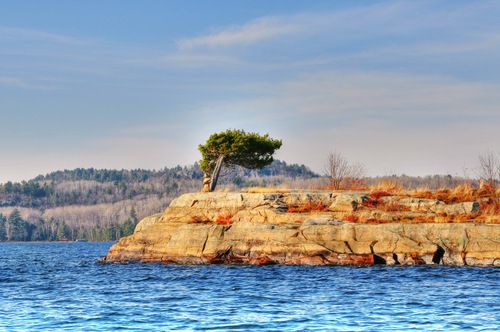
Lake Huron
This is Stacy’s story, as told by Aurora Wells, about navigating the loss of her husband, who drowned in lake Huron. Our “Opening Our Hearts” stories are based on people’s real-life experiences with grief and loss. By sharing these experiences, we hope to help our readers feel less alone in their grief, and ultimately aid them in their healing.
I was at the Toronto Airport customs checkpoint, propping my two-year-old Ivy in the crook of one arm, and filling out paperwork with the other. My heart stopped at “Marital Status:” — the pen pointed to “Married” like a compass.
With one slight but determined twitch, I reset its trembling mechanics; realizing seven years of marriage can be unwritten in a single moment. I remembered our wedding vows to be like old couples sitting on park benches. I checked “Single” and thought, I’m just Stacy now.
“I’m leaving the country because my husband died,” I answered, rocking Ivy on my shoulder. “In the lake.”
“Why are you here?” asked the officer, through glass.
“I’m leaving the country because my husband died,” I answered, rocking Ivy on my shoulder. “In the lake.” The officer remarked that he’d heard about the incident, and let us pass.
After the funeral and cremation in Ohio, where my husband Philip grew up, our daughter and I were airborne again — this time back to San Francisco. I noticed with some confusion that we were flying above Canada.
I couldn’t believe it when the intercom crackled alive: “And now, folks, we’re flying over Blind River, Ontario.” …How many times has that happened to you on a domestic flight to California?
It was August 1995. We had driven to Lake Huron from our architecture business office in Vancouver to meet Philip’s parents and some friends for our annual fishing trip. It was a family tradition pioneered by his grandparents many decades prior.
“The next thing I remember is the sound of his nephew screaming.”
I could hear Ivy giggling. Philip was raising her high, high above his head — and splashing her down gently, forming ringlets like tree years upon the water’s clear surface — when his fourteen-year-old nephew suggested they swim to some distant rocks. A friend said the water was shallow (and Philip was a lifeguard, besides)…
The next thing I remember is the sound of his nephew screaming. Setting Ivy down, sprinting with my husband’s father to the nearest canoe, and rushing out to the rocks as fast as our bodies could beat back the water.
We couldn’t find him.
“He told me to get away from him; he told me to swim…” repeated the frightened teenage boy when we pulled him aboard. My heart thumped in my ears. Harder it beat and lower it sank, hope drowning with every passing second.
“I watched the sun rise into a grey, misty morning — watched the zodiac boats and diving crew file into the water to bring my husband ashore.”
When the police arrived, they told us there had been another drowning in the lake that day, and the search would have to wait until morning. We went to a hotel, deep in shock.
I couldn’t sleep, of course. I watched the sun rise into a grey, misty morning — watched the zodiac boats and diving crew file into the water to bring my husband ashore. They found him: a mystery at the bottom of 12 feet of water. There was no indication of drowning or heart attack. To this day, I don’t know what stole Philip’s last breath.
Philip — the man I fell in love with at twenty, married at twenty-three. The man I had seen the world with; he who would sprinkle the stairs with paper hearts. We were meant to be together, plain and simple.
Without his work permit, I had to pack up and leave Canada in the throes of grief. I closed our San Francisco office, too. I needed my partner.
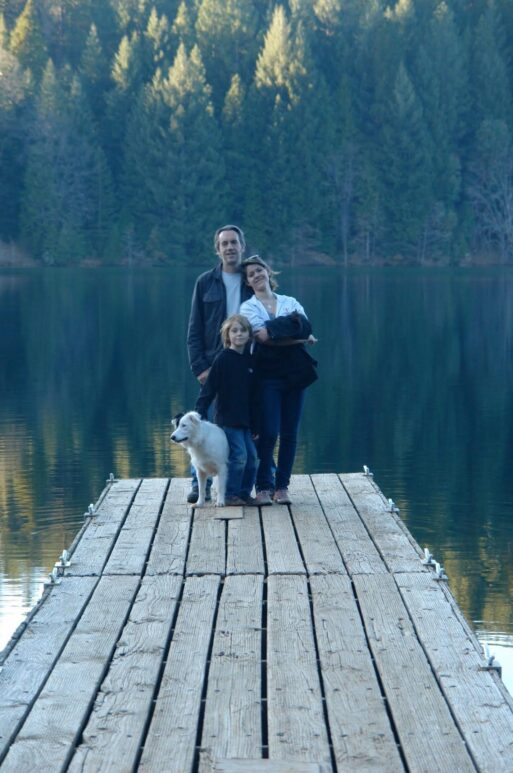
Years later on vacation by a lake. Happy again with George, our son and pup.
Credit: Stacy
In Ohio, I had been irked to receive his cremains in a black plastic box wrapped up with tape. When I arrived in San Francisco, I enlisted my friend Peter, a decorative painter, to help me create a beautiful web out of an antique silk kimono to place on Philip’s urn.
“I made the East Bay my home and started a business creating these wraps, partnering with someone who made elegant, expressive vessels…”
I made the East Bay my home and started a business creating these wraps, partnering with someone who made elegant, expressive vessels — and continued for about three years. Around the time we were first breaking into the funeral industry, I attended a friend’s wedding in England. I met George when Ivy started whacking him with her stuffed animal. He was a friend of the groom’s from architecture school at Columbia. We ended up sitting opposite each other at the reception dinner.
Six months later, he moved to Oakland. Two years later, we got married. We’ve now been together for over fourteen years, and have a nine-year-old son and an architecture firm together. I know Philip and George would have loved each other — and I can’t help but feel like Philip had something to do with us meeting.
Half of Philip’s ashes were buried in Ohio. The rest I saved for Ivy, for when she would be old enough to make decisions and remember. She just turned 18 and she’s a sailor now. This summer, Ivy’s going to take the rest of her father’s ashes out to sea, skippering the ceremony herself.





 Final Messages of the Dying
 Will I Die in Pain?