“A Monster Calls” Movie Review: J.A. Bayona Looks at Terminal Illness and Anticipatory Grief from a Child’s Perspective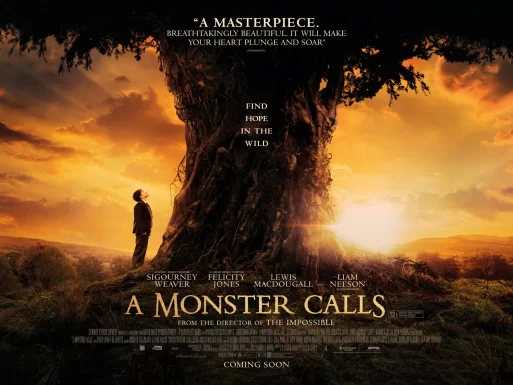
A film poster for “A Monster Calls” directed by J. A. Bayona.
Credit: Focus Features
In the 2016 film “A Monster Calls,” directed by J. A. Bayona, a 12-year-old child, Conor O’Malley, portrayed by Lewis MacDougall, endures a complicated and heartwrenching journey through his mother’s terminal illness. Based on Patrick Ness’s novel of the same name and the idea by Siobhan Dowd, “A Monster Calls” uses a unique blend of fantasy and drama to illustrate how people, particularly young children, experience illness and death.
The film introduces us to Conor in the middle of a deeply troubling and recurring nightmare—his mother is hanging from a precipice, and he struggles to hold onto her. We soon find out that his life is similarly precarious. His father is distant as his mother, portrayed by Felicity Jones, is dying from a long-term illness. His maternal grandmother, portrayed by Sigourney Weaver, provides support for Conor and his mother, but his reception of her is cold due to her seemingly strict demeanor. At school, Conor is the victim of frequent bullying despite the pity he receives from schoolteachers and staff. Between bullying, the complications of his parents’ divorce, and his mother’s illness, it seems he feels stuck and invisible.
One night, a large monster appears outside of Conor’s home as a living yew tree. It’s difficult to tell at first if this monster is another subject of Conor’s nightmares or a real threat. Voiced by Liam Neeson, he insists upon telling Conor three moral fables, after which Conor will tell him a fourth, based on Conor’s “hidden truth.”
The monster’s stories mirror struggles Conor faces in his real life—characters with complex motives, endings with ethical dilemmas, and meanings open for interpretation. Conor is frustrated with the stories at first, not happy with learning ethical lessons that good people can harm, and bad people can do good deeds. Nevertheless, the monster and its stories help guide Conor toward a painful truth about his life that he’s been burying due to his and his mother’s denial of her mortality.
Grief is a powerful theme and motive throughout “A Monster Calls.” It’s depicted in many different scenes as Conor struggles with emotional outbursts against authority, including his absent father and strict grandmother. Conor also faces destructive and sometimes violent tendencies due to the anger that grief often brings.
A poignant moment near the climax of the film involves Conor destroying an entire room’s worth of his grandmother’s cherished possessions; at first, he assumes that his destruction of property isn’t real due to the presence of the monster. However, he quickly sees that his subconscious has a tangible impact on reality.
Conor also sends a classmate to the hospital after being “possessed” by the monster to defend himself after being bullied. The monster often represents the conflicting, complex, and often ugly emotions associated with loss—and the lessons learned as a result.

Conor and his mother in “A Monster Calls.”
Credit: Focus Features
Conor’s emotional journey throughout the film, with both the monster and his mother’s declining health, reveals the fourth and final story. The recurring nightmare with his mother hanging from the precipice has less to do with the struggle to let go, and more to do with the struggle to hang on. Conor’s “hidden truth” is that he wants to let his mother go and accept her death. It’s a powerful moment, especially as the monster assures him that he is not a bad son or person for wanting his family’s suffering to end.
The monster beautifully summarizes this emotional epiphany: “You were merely wishing for an end of pain. Your own pain. Hers. That is the most human wish of all.”
Terminal illnesses are whole family affairs. It isn’t unusual for relief to join the complex array of emotions when facing the loss of a loved one after prolonged suffering. The film represents a universal struggle of families trying to come to terms with a heavy loss.
While the film isn’t subtle in its metaphors for grief and loss, it offers a compelling take on grief in the form of a monster. The moral fables, told through a watercolor-style animation, add a visually rich and dreamlike element to the story when blended with the gritty and dark reality of Conor’s “real life” world.
For someone experiencing or facing a loss from a terminal illness, J. A. Bayona’s “A Monster Calls” may open up fresh wounds, especially for those struggling to come to terms with their grief. However, it can also serve as a cathartic mirror into complex emotions that can help one heal or feel less alone.
The mother’s final words serve as a poignant reminder to embrace meaning and joy despite the difficulties loss brings.
“I know, my love. I know. And I want you to know one thing, Conor O’Malley. You will be alright. I promise you.”





 Final Messages of the Dying
 Will I Die in Pain?