“Life and Death in the Ancient World” at the Tampa Museum of Art
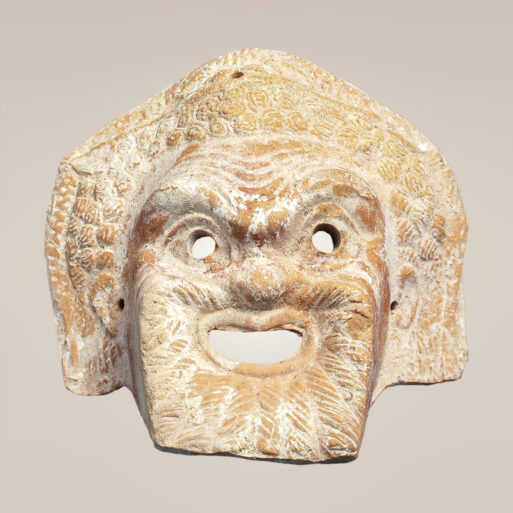
Mask of Father of Comedy Terracotta sculpture; Syria; Hellenistic period, ca. 2nd-1st cent. BCE. Gift of Mr. and Mrs. William Knight Zewadski to be shared jointly with the Michael C. Carlos Museum, Emory University, 1988.034.016
Credit: Tampa Museum of Art
Currently on display at the Tampa Museum of Art, the exhibition “Life and Death in the Ancient World” brings together 400 artifacts to draw connections between the contemporary and ancient worlds. Much like the lot of us living today, the museum’s website explains, people in the past were born. They married. They worked the land, went to war. They danced, drank wine, and of course, died. They were just like us.
From Roman coins, to funerary figurines up to 25,000 years old, to amphoras that held wine, to carved sarcophagi — the show casts a broad net, including an exquisite collection of objects from across the Mediterranean, from Greece to Egypt to Syria. It aims to introduce the public to “general aspects of life and death” that audiences today can relate to: what people used in their daily lives to amuse themselves and to bury and honor their dead. Their beliefs and systems of governance or “power and trade,” according to the museum, are also on display, if not tied into their funerary traditions.
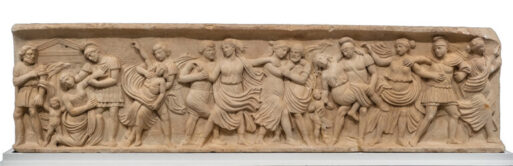
Roman marble sculpture dating to the Imperial period (ca. 150–200 BCE), depicting the Abduction of the Sabine Women. On loan from the collection of the White Family (Dr. F. Ashley White, Dr. Michele C. White, and Ethan A. White, Esq.)
Credit: artandantiqes.com
In a video, Branko Van Oppen, the Richard E. Perry Curator of Ancient Greek and Roman Art at the Tampa Museum, spoke about a marble sarcophagus from 150-200 CE. The abduction of the Sabine women carved in relief along its chest features a dynamic line of men snatching women. The story is tied to the myth of Romulus and Remus, the brothers raised by the breast of a she-wolf, one of whom found the city of Rome after killing his brother, Remus. As a city of men, they concocted a plot to take Sabine women as their wives to populate their nation. So, a foundation myth wraps around the walls of a final resting place as if the beginning and end were bookends that meet in the clasp of a bracelet — cyclical. “Bloodshed, crime, violence,” Van Oppen said, lies at the heart of Rome, but so does assimilation, mediation, and diversity.

Ceramic funerary vessel (volute krater) from Apulia, Italy, dating to the Hellenistic period (ca. 330–320 BCE). Tampa Museum of Art, Gift of Mr. and Mrs. William Knight Zewadski, 1986.
Credit: Artsandantiques.com
As with most — if not all — cultures, death inspires the imagination, if not works of art, as a deeply human experience in which we reunite with “all there is.” Also a principal in physics, we become one with the whole. We may differ in how we shape our understanding of it, but these artworks echo back at us, a belief that we return and remain, war and peace wrapped up in it, eternally bound.
These artworks also communicate the very human desire to leave a mark, to express ideas, and document experiences, and to hold onto social status — even in death.
The terracotta Father of Comedy theatrical mask on display speaks to our collective need for relief, to laugh—a means of making sense of and connecting to one another, our lives, and our worlds, a universal need the exhibit seeks to promote: connection.
“Life and Death in the Ancient World” seeks to bridge a gap between us and them, two disparate worlds that are more alike than different, so that we can more deeply connect to our shared human experience, acknowledge our long history of living and dying, and our innate desire to be remembered long after we leave our bodies behind.
The show will close in 2026.





 Final Messages of the Dying
 Will I Die in Pain?