Family-Directed Home Funerals Are Having a Resurgence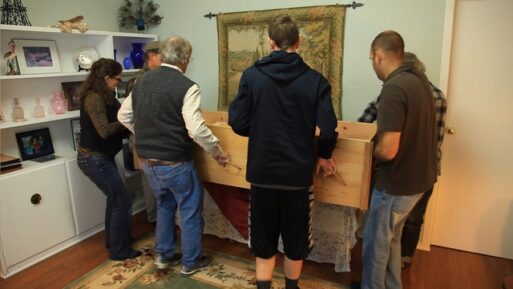
A family prepares to lift the hand-made casket holding their loved one.
Credit: Heidi Boucher
Heidi Boucher is a home funeral guide who has helped more than 100 families say goodbye to their loved ones, in their homes. It’s a practice that emphasizes a hands-on approach guided by intimacy, love and spirituality. She began learning how to care for the dead as a teenager while living in Sacramento with Nancy Poer, a legend in her own right in the family-led funeral practice. Together, they helped pioneer the grassroots movement that has grown into a national phenomenon.
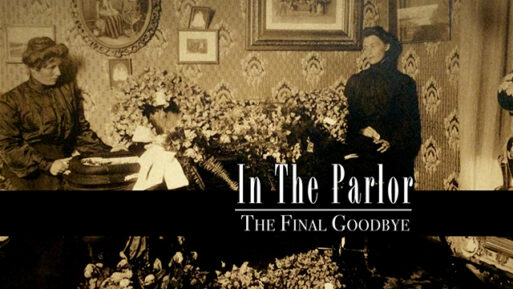
Her work — though performed in relative privacy — has received national recognition, including a feature in The New York Times Magazine. Boucher is also the writer, director and producer of the documentary “In the Parlor: The Final Goodbye” in which she follows the intimate journey of three families as they navigate caring for their dead at home.
Guiding family members through their final goodbyes is not a job Boucher takes lightly. She is passionate about protecting the practical, spiritual and emotional origins of the home funeral practice, and worries that the intentions behind the movement will fall prey to regulations and rules. She is a fierce advocate for families being able to make choices based on their priorities, especially when they are most vulnerable. It is her dedication to the craft that makes Boucher so remarkable.
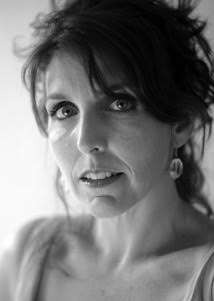
Heidi Boucher
Credit: In the Parlor: The Final Goodbye
This interview has been edited for length and clarity.
I think the best way to start out is to talk a little bit about the history of family-directed funerals performed at home.
Well, that’s kind of a big one, and it actually depends on who you talk to. I can only speak from my experience, and from my doing this for such a long time.
I think the history of home funerals is still being worked out, because it’s relatively new and so it’s hard to pinpoint. To my knowledge, the home funeral thing kind of started with Lisa Carlson writing [“Caring For Your Own Dead”], and her taking the initiative to do something about her situation back in the ’70s. (Editor’s note: Carlson also co-authored a book in 2013, “Final Rights: Reclaiming the American Way of Death,” that tackled another part of the funeral industry.)
I think it’s important to clarify, though, that different cultures have been doing this forever. So when we say home funerals, we’re talking about conventional Americans doing them; just the sort of regular mainstream person. Because there were whole cultural sections and swaths of the country that have been doing it for a long time, but it mostly disappeared.
But for our purposes, my understanding is that family-led funerals started again in the late ’70s, when I was young. We were on the West Coast — Sacramento. It grew out of this sort of little seedling — again, there could have been other people doing it — but this conscious birth of home funerals really started out here, with Nancy Poer and myself. In the late ’70s no one else was doing it; people definitely thought, “Oh my God, what are these people doing?”
Then it grew, and more and more people in our spiritual communities were doing it, and it started to spread to other little satellite points.
How did you discover family-led home funerals? What was Nancy Poer’s role?
When I was in high school, our family lived an hour away and I went to a private school here, the Sacramento Waldorf School in Fair Oaks. And because my family moved away when I was a teenager, I boarded with Nancy Poer. Her daughters were my best friends, and went to the same school, so it just made sense.
I spent a lot of time over there, riding horses and playing and being a scrappy tomboy with her girls. We lived in a great big house; an old Victorian three-story on acres and acres. It was just incredible, super beautiful. Between the animals and children – Nancy has six children – it was a chaotic family life, but in a wonderful way.
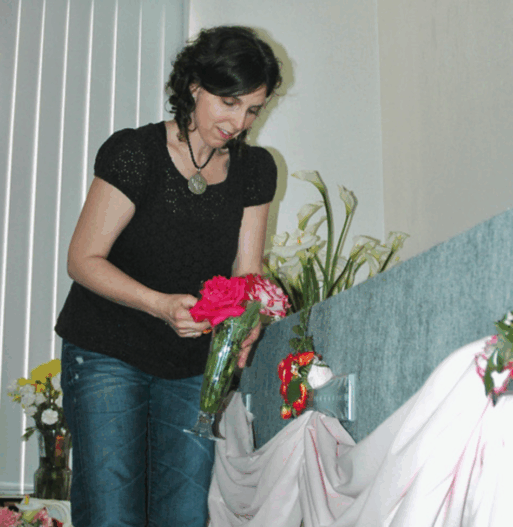
Heidi Boucher, a home funeral guide, decorates a cardboard casket with fresh flowers and fabric to present the body of a loved one for a family to view and say goodbye in their home.
Credit: Heidi Boucher
While I was living there, Nancy was taking care of some elderly communities and her elderly family members, so it was just what I saw. As we would be running in, or doing chores, we would pop in and say “hi” to the old people. And, you know, I didn’t know any better [that things could be different]. I would go home on the weekends with my family — I was the oldest of five children — so it would be this cross-cultural,if you will, childhood of big families, chaos and joy and play while being respectful and mindful of the fact that there were old people in our lives.
So, one family member in particular, Grandma Goodman, was a very, very old, beautiful little tiny old woman. It was getting closer and closer to her time, and so Nancy was like, “You know what? We’ve gotta get a casket ready for her, because we’re going to keep her home and we’re going to do a vigil and we’re gonna do the whole thing.”
So, I think I was about 16 at the time, but I’ll never forget: the boys made the casket and the three of us girls were in charge of sanding it. So the casket was brought into the living room and little Grandma Goodman is sitting in her wheelchair by the fire and we have the casket on the floor in the living room, right there in front of the fire, too, because it was a big, old, creaky house. And she’s sitting there in her little wheelchair with her shawl wrapped around her, just saying, “Girls, what are you doing?” And we would say, “Well, we’re working on a school project.”
So she didn’t know that it was her casket you were preparing?
I don’t think so. But once it was sanded, we lined it with satin and silk, and got it ready. And that was kind of the M.O. [modus operandi]: They would have these lovely old people that would be living with them, and there was always a casket kind of ready to go, that the boys would make and then we would either help stain it, or dye the silks, and line it with satin, or whatever was needed, we were tasked to do.
So when she did die, or any of the other elderly died, it was kind of a family and community event. It didn’t even occur to me that you might pick up the phone book and call your local funeral director.
So it became a very normal part of my growing up, being part of this activity that Nancy and her husband so lovingly did.
What were their motivations to start doing this? Was it out of financial necessity, or more of a spiritual process that they just preferred?
I don’t think it was financial. I mean, it could have been, but I think that was low on the list for Nancy. Knowing her and knowing her well, the spiritual part is No. 1. And then that aspect beautifully married with this pioneer, hands-on, “we’re gonna do this” approach. It was a lovely balance of spirituality and practicality at its finest. Because when you meld those two things, it really makes the ritual complete, and really rich. They lend meaning to each other, and … it’s hard to describe, but it felt really normal. It felt like, “this is what we should be doing.”
I like to compare it to when you’re having a baby: you gather the midwives, boil the water, get the clean sheets … You come together and it’s a holy moment, just the fact that a new being is coming into your presence. But you also need to grab onto the practicality of what you need to do to accommodate a healthy birth; preparations are necessary.
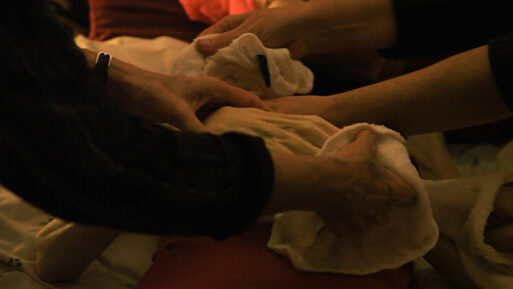
Family members prepare the body of their loved one in the documentary “In the Parlor.”
Credit: In the Parlor: The Final Goodbye
Nancy was also really inspired by Lisa Carlson’s book, “Caring For Your Own Dead.” The book came out in 1978, or something like that, and in our little Waldorf community, we had been caring for our own dead already, in the sense that someone would die and we kept them at home for as long as we could, up to 72 hours. So the Waldorf community, the people in that philosophical movement, that’s really where this kind of work was alive and kicking, if you will. We just took it a step further.
How did your local tradition grow into a movement?
Well, it just kind of spread. Over the years Nancy and I became the people that other people called upon to do the work. There were other women in the community that helped, too, but we were often the ones kind of delegating. For so many years the process would be us saying, “OK, this is what we’re gonna do, this is how we’re gonna do it,” with Nancy and I calling each other back and forth and asking each other for insights.
Then, in the last decade family-led funerals have just boomed. It’s actually phenomenal. Some of that growth can be attributed to other people, like Jerrigrace Lyons with her training centers, and Beth Knox out on the East Coast … they really helped spread the word. And then, of course, articles and films and things like that have helped as well.
Have you noticed any commonalities between the people who choose to have family-led, at-home funerals? In your experience, what has caused more people to choose this unorthodox method?
That’s a really good question, because it’s hard to pinpoint the “why.” I think it’s for spiritual reasons, for some it’s financial, and some families come to it because they had a horrible experience with a funeral home in the past. Many families just learned about the practice and think it’s cool, and they want to have a more individualized, intimate experience with their loved one. Some come to do it because it’s what the dying person requested. You never know what the reason is going to be, because it’s across the board.
Can you clarify the differences between home funeral guides and death doulas?
Here’s another example of everyone kind of figuring it out as we go. People are going to define them differently, say different things. But my understanding is that death doulas are really there in the before, supporting the family and the individual before and during death. Then, once the death happens, the home funeral guides come in.
That being said, I think a lot of death doulas are now crossing over into the other realm — and vice versa — which is great. People ask me if I’m a death doula, and I honestly don’t know if I am. I just know that I’m a home funeral guide helping families navigate from the point of death, on. I meet with most of my clients beforehand to find out the families’ preferences, but it’s different.
The thing is, home funeral guides came on the stage first. And then the death doulas started years later, and we’re all trying to navigate what our roles are. It’s an area in which boundaries probably haven’t been made really clear or hard and fast, and that’s OK, because different families will want different services.
How has the practice changed over the years, now that it’s grown enough for there to be a national organization — the National Home Funeral Alliance — and various training programs and workshops led by home funeral guides?
There are more extreme approaches than mine, that I think might have come from the Lisa Carlson book (she did everything herself), and that’s great. Families should, and can, do that. But just because you have different styles of how you do it, it’s still a home funeral as far as I’m concerned. Some people want to give it different names, but the bottom line is: the family’s caring for the dead, at home. It’s not every day you have a deceased person in your living room or your bedroom. Like, if I bake chocolate chip cookies a different way than you make them, and it’s different than how he makes them … they’re all still chocolate chip cookies.
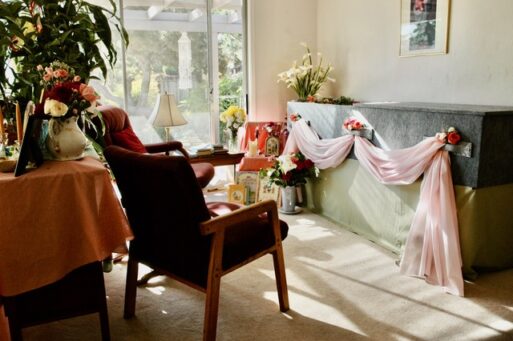
Boucher often helps the family prepare a space in the home, a place of reflection and remembrance for the body to stay for up to 72 hours.
Credit: Heidi Boucher
I think it’s important that people know that they have options.
My fear is that as this movement grows, people are taking it and saying, “it has to be done this way, and this has to be done that way.” It’s starting to become a little bit, maybe, overregulated. Over-thought. We have to be careful when we rule that this is how it has to be, or else we’re going to call it something else. It should be the family that decides.
To do this act of bringing a deceased loved one into their house, to bathe and dress and create a space for them, that’s a home funeral. That is a family-directed funeral. All the other minutia behind it doesn’t matter. I don’t want people to lose sight of the bigger picture, which is that any person who decides to be in the presence of a deceased loved one for 72 hours, or 24, or 48 — that counts.
What is the significance of the number of hours the body stays at home? Is it important to the whole concept of a home funeral?
The 72 hours goes way, way back, to biblical times. Different spiritual modalities have talked about the 72 hours, or three days. It’s a very significant holy time.
But it’s really fascinating to be in the presence of a dead body for 72 hours. There’s a term that I have coined, I call it the Breathing, Sleeping, Gone experience. So many people have it, it’s almost universal.
The first day, people are standing around the casket or the bed, and they’re looking at the person and they’re saying, “Oh my God, it looks like she’s still breathing.”
And the next day, they come back and they look at her and they remark that it doesn’t look like she’s breathing anymore, now it just looks like she’s sleeping.
And then the third day, they come up to the body and decide, “Oh. She really looks gone.”
It coincides with this feeling of, “Oh, it’s time. I’m ready to let go.” It’s hard to put words on it, really, because you have to experience it. But it generally takes those 72 hours to feel like you’re ready for the next step, which is incredibly hard, which is when the body leaves the house. There’s this moment of realizing that everything is real, and now your loved one is literally and figuratively crossing a threshold, and you feel the next wave of the journey beginning.





 Final Messages of the Dying
 Will I Die in Pain?