New Research Reveals That Light Emitted During Life Is Extinguished After Death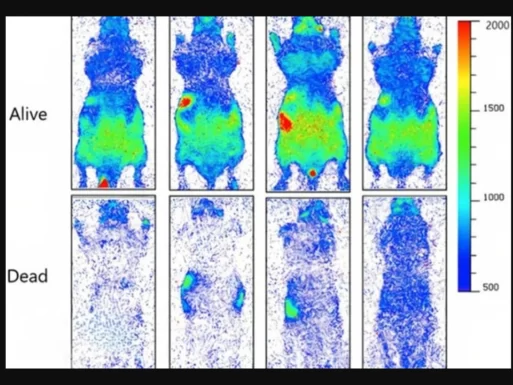
Images from the study show light emissions fading after death.
Photo by University of Calgary
New research using ultrasensitive cameras published in The Journal of Physical Chemistry Letters has revealed that a certain type of light emitted by living organisms fades during the death process.
All living things emit a (very) soft glow, known as biological ultraweak photon emission (UPE). A byproduct of metabolism, this faint illumination had already been identified in 2009. This new study by Canadian scientists is the first to compare the intensity of emissions among healthy, stressed and dead specimens.
As one of the researchers involved told the National Post, “The notion of life giving off its own glow could strike some people as an almost mystical effect.” But that’s not the case. Researcher Daniel Oblak went on to say, “It’s not an energy field that surrounds a person.”
The study, which was carried out by the University of Calgary in partnership with Human Health Therapeutics Research Centre at the National Research Council in Ottawa, found “significant contrast between the UPE from live vs. dead mice,” while in plants, there was a marked increase of emissions among stressed and injured specimens.
According to Oblak, their findings constitute proof of UPE as an inherent quality of life.
“This really shows that this is not just an imperfection or caused by other biological processes. It’s really something that comes from all living things,” Oblak told NewScientist.
In an interview with Canada’s CTV News, authors of the study noted that the light they imaged is distinct from body heat, and is not any kind of metaphysical glow. “We metabolize; we give off light. … That does not imply anything else than we’re producing energy,” said Oblak.
Using highly specialized cameras known as electron-multiplying charge-coupled devices and charge-coupled devices, the scientists were able to record this phenomenon, which occurs within the visual light spectrum but is too faint for us to see.
The experiment was conducted by placing four immobilized mice within a dark, temperature controlled box, according to Science Alert. The cameras revealed that while light is still emitted from some organs after death, overall emissions were significantly decreased in mice within 30 minutes after euthanasia.
“While the live mice emit robust UPE, likely indicative of ongoing biological processes and cellular activity, the dead mice’s UPE emission is nearly extinguished,” the team reported in the study.
Researchers also stressed plants by inflicting injury via cutting, exposing them to chemicals and increasing temperature. These experiments showed significant increases in light activity in response to these stimuli, with the strongest reactions resulting from the application of anesthetics to injury sites.
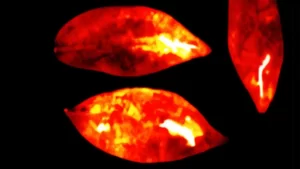
Ultraweak photon emissions captured by researchers using highly sensitive cameras
Photo by University of Calgary
Of the plants’ reaction of stronger light emission to the pain reliever benzocaine, “We still don’t know the main source,” study co-author Vahid Salari told CTV News. “We have some speculation, like a (sodium) channel or the release of more reactive oxygen species.”
“UPE imaging provides the possibility of non-invasive … imaging of vitality in animals and the responses of plants to stress,” the paper said, noting that UPE could be a promising tool moving forward.
While possible use cases arising from the study results are limited by the scope of this initial research, the findings open doors to future inquiry, and carry revolutionary implications for diagnostic practices in humans and other animals as well as agriculture.





 Final Messages of the Dying
 Will I Die in Pain?