Bill Would Allow Veterans Options in Burial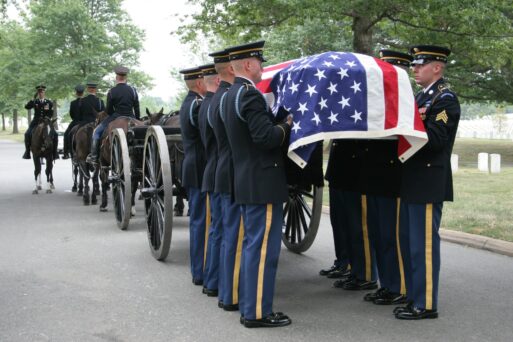
Soldiers carry casket during military funeral.
Credit: Tom Olson via Unsplash
U.S. Rep. Julia Brownley (D-CA) has introduced the Loved Ones Interment Act, a bill that would allow veterans who are cremated and receive an urn or plaque from the U.S. Department of Veterans Affairs (VA) to be buried in a national cemetery. Under the current law, a family is not allowed to do both.
The National Cemetery Administration states: “If a family chooses an urn or a plaque to commemorate a Veteran, VA is prohibited by law from interring that Veteran’s remains in a VA national cemetery or from providing a headstone, marker or medallion for placement in any cemetery.”
The Current Law Prevents Families From Being Buried Together
The VA rules, as they stand, can potentially affect grieving families in multiple ways. First, they cannot follow the burial wishes that might have been expressed by their loved ones. The family of a veteran who wishes to be interred at a national cemetery may need to hold on to the urn without receiving military honors at a national cemetery.
These rules also keep families apart. Family members are allowed to be buried in national cemeteries, which means a spouse or child may be interred before the veteran dies. If the veteran cannot be buried in the cemetery, they may be separated from their loved ones in death.
As reported in Stars and Stripes, “VA has said it has no choice in the matter, pointing to a law that Congress passed in 2020 authorizing the VA secretary to furnish urns and plaques to deceased veterans under the condition that other burial benefits are not provided.”
The law is the Isakson and Roe Veterans Health Care and Benefits Improvement Act of 2020.
The New Law Also Simplifies Burial Planning
Along with eliminating the emotional distress of separating veterans from their families, the Loved Ones Interment Act would also make end-of-life planning easier, according to an article in Connecting Directors, a funeral industry publication that also notes the act has bipartisan support. Families wouldn’t have to choose between a plaque and a burial in a national cemetery.
In life, veterans can discuss their burial desires without worrying about what their benefits cover. When a family member dies, their loved ones can focus on grieving, not on making the right choice when navigating complex VA laws.
The ineligibility guidelines for veterans who purchased urns or plaques are new. They only went into effect in June 2024, implementing the Improvement Act of 2020, leaving many veterans and families confused about their benefits. This bill could be viewed as a correction to the recent guidelines.
“It is heartbreaking and completely unacceptable that VA’s current interpretation of the law prevents cremated veterans from being buried with their family members because of limitations placed on burial benefits,” says Brownley.
“Our nation’s veterans and their families have sacrificed so much in service to our country, and ensuring that veterans are laid to rest with their loved ones is essential for upholding our promise to serve our veterans – in life and death – as well as they have served our country.”





 Final Messages of the Dying
 Will I Die in Pain?