Canada’s Medical Aid in Dying: “I cannot get through a day. It’s physical torture.”
Health Canada
The New York Times recently published the profile of Paula Ritchie, a Canadian woman who elected to take part in the country’s controversial medical assistance in dying (MAID) program. Her life, one plagued by emotional and physical suffering, once again draws the debate over MAID into focus: who has the right to decide when or how a person dies? Stories such as this and the recent news about how Nobel Prize winner Daniel Kahneman chose to die demonstrate that the debate over medical aid in dying falls in a moral gray area, and doesn’t seem likely to conclude anytime soon.
Canada’s MAID laws, like a very few other countries, do not require a patient to have a terminal illness. The law requires simply that the patient “have a grievous and irremediable medical condition” — a phrase that is notably vague.
Ritchie’s story illuminates the difficulties in defining the boundaries between morality and legality in end-of-life choices, including who gets to decide.
Paula Ritchie’s Story
To produce this profile, Katie Engelhart — a journalist who has specialized in medicine and ethics for nearly a decade — spent hours interviewing Ritchie about her life and medical history, as well as reviewing her medical records, legal documents and personal diaries. Ritchie complained that she suffered from debilitating symptoms due to post-concussion syndrome, in addition to having a history of chronic pain, mental illness and childhood trauma. Englehart describes how Ritchie’s life had been characterized by periods of mental instability, difficulties maintaining employment and housing and numerous undiagnosable medical symptoms. She’d sought treatment many times, with varying results, and attempted to take her own life on multiple occasions.

Photo from Paula Ritchie’s Obituary
Credit: Blair & Son Funeral Directors
Engelhart was with Ritchie on her final day and described how everything went: who was there in support, what the process looked like and even Ritchie’s almost humorous anxiety over seemingly minor details. Although the occasion was sad, the overall impression is that Ritchie was finally getting the relief she’d so desperately sought.
Canada’s Unique MAID Provisions
Canada is one of several countries that allow medical aid in dying for people meeting certain criteria. The Netherlands, for example, also provides medical aid in dying for those without a terminal diagnosis, but it requires that both the physician and the patient agree that all potentially effective means of alleviating suffering has been tried before they can get approval. However, Canada does not explicitly require that MAID be a last resort. In 2021 Canada passed Bill C-7, significantly broadening the eligibility requirements for MAID to “reduce unnecessary suffering.”
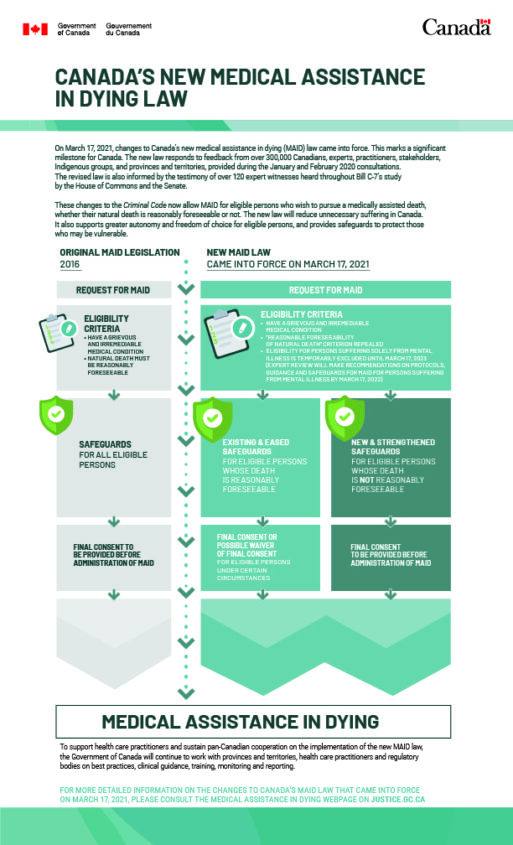
Infographic showing the changes in Canada’s MAID laws with the passage of Bill C-7
Credit: Government of Canada
According to the governing document “Advice to the Profession: Medical Assistance in Dying (MAID),” people can be eligible for MAID even if there are treatments or resources that would make their suffering tolerable but are inaccessible due to lack of availability, extended wait times, financial insecurity or other “systemic barriers.”
The Issues Shaping the MAID Debate
Perhaps the main issue with Canada’s MAID eligibility requirements is that the law does not define what it means by “suffer” or how a medical professional is supposed to evaluate the suffering. As Engelhart reports, Canada’s “Model Practice Standard” instructs MAID assessors to “respect the subjectivity of suffering.” That leaves an opportunity for MAID to be applied in unexpected and possibly undesirable ways.
For example, opponents worry that MAID will provide reasons for the government to not seek to improve social services. Many people with chronic conditions are unemployed, unhoused and impoverished; in turn, their medical problems are made worse by these unmet needs. Opponents argue that these people would be deemed “incurable” and “irremediable” because they don’t have the means or social services to support their efforts to become well. Instead, the government would be able to save money in health care costs by allowing their suffering to come to an end.
As one physician wrote in an opinion piece in The Conversation: “I believe we’ve experienced a bait and switch: laws initially intended to compassionately help Canadians avoid suffering a painful death have metastasized into policies facilitating suicides of other Canadians seeking death to escape a painful life.”
While the link between chronic health struggles and poverty is undeniable, at least some data suggests that at least so far, MAID is not what opponents fear. A 2022 paper, “Are Unmet Needs Driving Requests for Medical Assistance in Dying?,” collected testimony from 20 MAID providers to examine whether medical, financial or social needs were driving MAID requests. The qualitative review of over 3,700 MAID requests found that unmet needs were rare — although providers reported an ethical dilemma when loneliness and poverty were a factor, knowing that some of their patients’ suffering was due to society’s failure to provide for them. (Engelhart points out that the paper noted “many evidence-based treatments that ameliorate quality of life” for people with chronic conditions were not covered by public health insurance.)
Additionally, proponents argue that the eligibility requirements under the Bill C-7 that was passed were necessary because the system fails people. An often-cited case involves a quadriplegic man, Normand Meunier, who developed a critical bed sore after a hospital failed to provide him with a specialized mattress the hospital actually had during an ER stay. The painful pressure sore would take months to heal, if at all, but was also likely to lead to infection, sepsis and death. Meunier opted to undergo MAID in 2024. As MAID advocates would argue: His pain and suffering were preventable, but should he have been given no choice about enduring it?
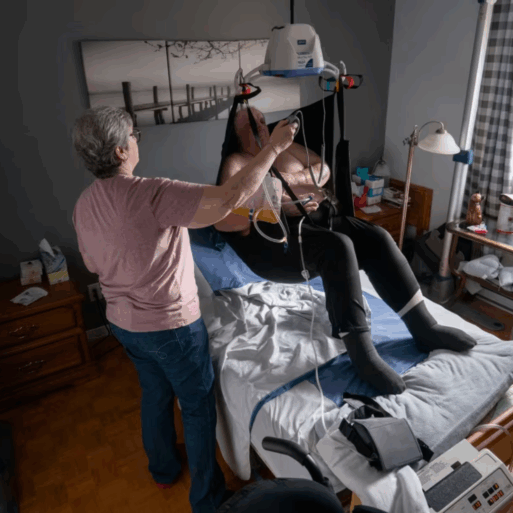
Normand Meunier had been paralyzed in his arms and legs since 2022
Credit: Ivanoh Demers/CBC
More commonly, though, Bill C-7 was intended to provide relief for those suffering from afflictions that modern medicine is unable to address. As Engelhart wrote, “Even the best palliative care doctors — physicians whose entire careers were devoted to pain management — came up against symptoms they could not beat.” Denying MAID to eligible patients “on the grounds that they could be cured with more and more treatment, was allowing them to be held hostage to an unfounded belief in total recovery.”





 Final Messages of the Dying
 Will I Die in Pain?