How Pope Francis Was Laid to Rest
Pope Francis waves to crowds in Prato, 2015.
Photo Credit: Wikimedia Commons
The death of a pope signals the beginning of a number of traditions and ceremonies within the Catholic Church, and more specifically, the Vatican. Among these, the handling of a pope’s mortal remains is a process that has long been prescribed – relatively openly – despite the shroud of secrecy that surrounds many other Vatican activities. Euronews described the preservation techniques used to prepare Pope Francis’ remains for his public veneration in St. Peter’s Basilica, as well as some interesting details about his funeral.
(And, just to be clear, the rumor going around social media that a pope needs to be tapped on the head three times with a ceremonial hammer to verify his death is a long-held myth, according to fact-checking website Snopes.)
Changes to Funeral Practices
Pope Francis, who died last month at age 88, made several changes to the funeral process in the Ordo Exsequiarum Romani Pontificis, the Church’s liturgical book for the funeral rites of popes, the Catholic News Agency reported. The new edition, issued last year, was requested by Pope Francis from a desire “to simplify and adapt some rites so that the celebration of the funeral of the bishop of Rome better expresses the Church’s faith in the risen Christ, eternal Shepherd.”
Many of the changes reflect Pope Francis’s distaste for ostentation, such as eschewing the usual three coffins of cypress, lead and oak for one made of wood with a zinc lining. He also insisted that his body not be displayed on an elevated bier, or catafalque, because he believed that it was more fitting, as the pope’s role was to be a simple pastor, not a world leader.
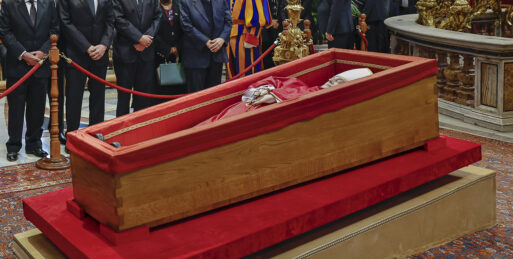
Photograph taken during Pope Francis’s Funeral in St. Peter’s Basilica
Photo Credit: Ricardo Stuckert for Lula Oficial, via Wikimedia Commons
Another notable adjustment was Pope Francis’ desire to be interred in the St. Mary Major Basilica, near an icon of the Madonna that he revered, instead of St. Peter’s Basilica’s crypt, where popes have been buried for over a century. The archbishop who administers St. Mary Major Basilica told PBS News that Pope Francis chose this place of burial because it reflected his “humble, simple and essential life.”
Thanatopraxis
For hundreds of years, popes’ bodies have been preserved to meet the practical demands of lengthy funerals, public veneration, and for spiritual reasons, Euronews explains. In the past, popes were subject to embalming, which involves removing internal organs and injecting substances such as formalin and alcohol. Over time, however, an emphasis on maintaining the dignity of the human body led the church to adopt more “discreet and respectful methods.”
Euronews reported shortly after Pope Francis’ death that his body underwent thanatopraxis, a body preservation technique used mainly for the public display of corpses. This practice, regulated in Italy under a law passed in 2022, is considered a modern evolution of embalming.
The procedure involves the injection of preservative fluids into the arterial system, complete disinfection of the body, corrective makeup, and an artful arrangement of the hands and face to ensure a serene and composed appearance. According to Euronews, thanatopraxis slows down the decomposition process and allows the natural appearance of the deceased to be maintained for several days.
For many devout Catholics, honoring the pope after his death is more than a tradition, it is a deeply spiritual act filled with reverence and gratitude. As the many photos of his remains on display can attest, thanatopraxis preserved Pope Francis well as he accepted this gesture from hundreds of thousands of the faithful.





 Final Messages of the Dying
 Will I Die in Pain?