This Mountain Sanctuary Is Charting a New Path in Death Care
Sunset over the mountains in nearby Yancey County.
Image by S. Preston Duncan
Nestled in a 6-acre swath of the Swannanoa Valley in Appalachian North Carolina, the Center for Conscious Living & Dying (CCLD) offers something invaluable for free: community. Powered by nearly 300 volunteers, the center provides end-of-life care in the comfort of a homelike environment. While this is a noble endeavor in itself, what sets this sanctuary apart is that it’s not just for people who are dying.
While there are many inpatient facilities that offer care for the terminally ill, they largely operate as separate places to which death is sequestered, offering services the living dread to require. CCLD doesn’t simply refuse to engage in the compartmentalization of dying, it is actively dismantling it.
The nonprofit center was founded by Dr. Aditi Sethi, a palliative care doctor and death doula with 10 years of hospice experience. While working at a 26-bed in-patient hospice facility, Sethi was struck by the sense of crisis and fear with which her patients were facing the end-of-life process. Spurred by the conviction that there was more to end-of-life care than easing physical pain, she began exploring other, more human-centered approaches. This led her to create a center designed for the individual experiences of patients, allowing them to approach dying in a way that honors their emotional, psychological, spiritual and physical needs.
As Philadelphia magazine reported in 2024, “Sethi thought the center would see a trickle of people interested in helping carry out its mission. But before she’d even opened its doors, more than 200 volunteers stood ready to step in.” CCLD’s opening announcement spelled out how volunteers create community: locals participate on nearly two dozen teams “that create beautiful grounds, contemplative spaces, Airbnb rooms to rent, and our Sanctuary Transition Suites where we host three guests at a time who are in their last days.”
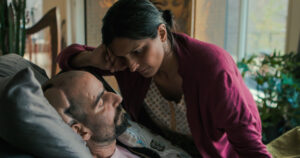
Dr. Sethi and Ethan in the film “The Last Ecstatic Days.”
Image courtesy of The Last Ecstatic Days
In 2021, according to her bio, Sethi met Ethan Sisser, a 36-year-old man dying of
a glioblastoma. His dying wish to film the end of his life as part of a community-
engaged process resulted in the movie “The Last Ecstatic Days.” Three years later,
CCLD opened to the public.
Since its grand opening in May 2024, CCLD has not only offered free rooms and services to the dying and their families, but community events such as choir performances, shamanic drumming workshops, grief circles and yoga sessions.
“Anyone who wants or needs this type of care is welcome here, unhoused, uninsured or single. This is a residential home that is run and supported by volunteers,” Sethi told WLOS, ABC 13 News.
The center’s mission is to “create a community that embodies living a meaningful life through inner exploration and growth, service, and community-supported end-of-life care,” which, according to its website, is to be accomplished through conscious living — an ongoing intention to be present in each moment. This philosophy refuses to separate living from dying, just as the center itself refuses to separate people who are actively dying from those who possibly have a bit more time.
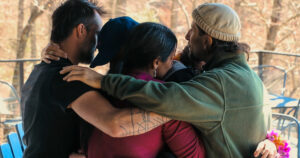
The community deathcare team for Ethan Sisser huddles in.
Image courtesy of The Last Ecstatic Days
By embracing the interconnectedness of life and death, CCLD primarily teaches the art of being alive. It helps guide others in the practice of experiencing life as breath — something that moves through our bodies without intrinsically belonging to the corporeal. This approach enlivens the cycle of being and nonbeing, and in following it, the center provides a space in which fear can be hosted with compassion, appreciation, and acceptance of its transience. Just like any other guest.




 Final Messages of the Dying
 Will I Die in Pain?