“My Brother” by Effie Waller Smith
Effie Waller Smith was famous for her poems describing the Appalachian Mountains, where she grew up.
Born to formerly enslaved parents in the rural mountain community of Chloe Creek, Kentucky, Effie Waller Smith was a prolific poet in the early 20th century. She is most notable for achieving moderate literary success despite being a woman and a person of color during a time of widespread racism and sexism, but her artistry with words stands as a testament to her consummate skills. In her poem “My Brother,” about her youngest sibling, Marvin, she was able to encapsulate the unique grief associated with losing someone while they were in the prime of their life.
About Effie Waller Smith
Because Smith’s father, Frank Waller, had been taught blacksmithing while laboring as a slave prior to the Civil War, he was able to provide a relatively affluent life for his family in their racially integrated community. This allowed Smith and her older siblings, Alfred and Rosa, to complete eighth grade at a local school, and then attend the State Normal School for Colored Persons in Frankfort. According to various biographies, she trained to be a teacher, and taught school off and on for several years in Kentucky and Tennessee.
According to JoEllen Wollangk, writing for the Neenah Historical Society, Smith started publishing poems in local papers at a young age, gaining numerous followers. One of her patrons was Mary Elliott Flanery, a Progressive Era social reformer and the first woman elected to a Southern state legislature, in 1921. Flanery, Wollangk surmises, and other local residents most likely helped finance Smith’s first book of poetry, “Songs of the Months,” in 1904. (Flanery even wrote the introduction to the collection.)
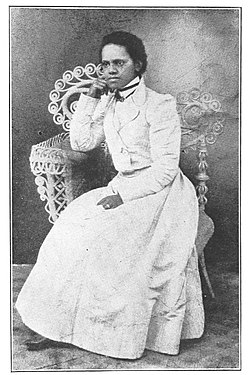
Effie Waller Smith
(Frontispiece to “Rhymes from the Cumberland”)
Photo Credit: Wikipedia
Smith also gained early national recognition by being cited as an example of a successful African American in the Rev. James Jefferson Pipkin’s book “The Negro in Revelation, in History, and in Citizenship.” The book, an “attempt by a Southerner to rise above deep-bred prejudices and objectively list the known accomplishments of African Americans following the end of slavery,” as The New York Public Library Digital Collections describes it, was almost a “Who’s Who” of people of color, published in 1902.
Thanks to this combination of local support and national recognition, Effie Waller Smith was one of the first female African American poets to be published in a national literary magazine. Ultimately, seven of her works were printed in major American literary magazines between 1908 and 1917, including Putnam’s Monthly and Harper’s Magazine. She also published two more books of her poetry, both in 1909: “Rhymes from the Cumberland” and “Rosemary and Pansies.”
Her Poem “My Brother”
Although Smith is best known for her poetry celebrating the beauty of the Appalachian mountains, many of her more personal poems, like “My Brother,” revolve around the contemplation of life and death. Smith, sadly, was no stranger to loss. In 1904, she married a transient railroad worker, who left her for another woman shortly after. She married her second husband, childhood sweetheart Charles Smith, in 1908. Their first and only child died soon after it was born, which she wrote about in her poem “To a Dead Baby.” Then, in 1911, Charles was shot and killed in the line of duty as a deputy sheriff.
Little is known about Marvin Smith, Smith’s youngest brother, other than the fact that he was born in 1882 and died of unknown causes in 1903. Her poem “My Brother” was published in “Rosemary and Pansies” six years after his death.
Dead! And he has died so young.
Silent lips, with song unsung,
Still hands, with the field untilled,
Lofty purpose unfulfilled.
Was that life so incomplete?
Strong heart, that no more shall beat,
Ardent brain and glorious eye,
That seemed meant for tasks so high,
[…]
Could the death-dew and the dark
Quench that soul’s unflickering spark?
Are its aims, so high and just,
All entombed here in the dust?
O, we trust God shall unfold
More than earthly eyes behold,
And that they whose years were fleet
Find life’s promises complete,
Where, in land no gaze hath met,
Those we grieve for love us yet!
After lamenting that her brother’s life was cut so short, she wonders if death could really be the end. This is a common thread throughout Effie Waller Smith’s many poems expressing loss and bereavement: Smith seeks solace in her faith that she would be reunited with loved ones in the hereafter. Not only did she hope that they’d find fulfillment in an afterlife, where Marvin might “find life’s promises complete,” but they would, in turn, be loving her from there until she could join them.





 Final Messages of the Dying
 Will I Die in Pain?