
Nature’s first green is gold,
Her hardest hue to hold.
Her early leaf’s a flower;
But only so an hour.
Then leaf subsides to leaf.
So Eden sank to grief,
So dawn goes down to day.
Nothing gold can stay.
Though it’s a mere eight lines, Robert Frost’s compact poem about the inevitability of loss has found an enduring place in American literature. While it doesn’t specifically deal with death, it can be taken as a reflection on impermanence and the inescapable end that awaits all living things.
Frost, who was the only poet to receive four Pulitzer Prizes for poetry, published the poem in 1923 when he was 49. It was an age much closer to death at the time — the average lifespan for men was about 58 years old — than it is today, and ripe for profound reflections on life.
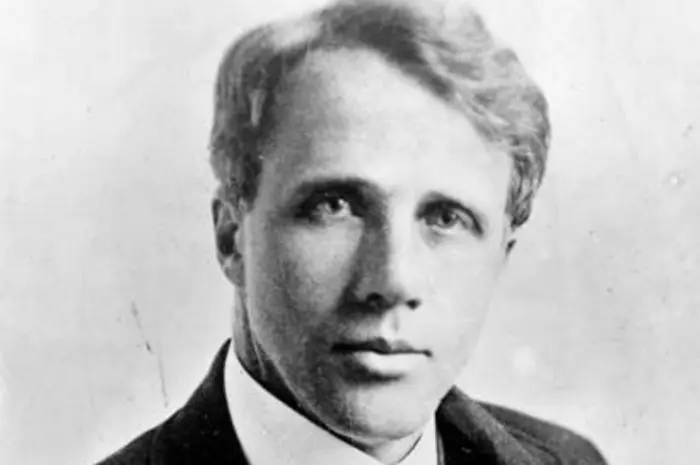
By that age, Frost had experienced devastating loss. When the poet was 11, his father died of tuberculosis. Frost’s mother died of cancer in 1900. His son Elliott died at age 4, and his daughter Elinor died shortly after her birth.
Perhaps the experience of losing children contributed to the sentiment behind the first two lines of the poem — “Nature’s first green is gold/Her hardest hue to hold” — implying that the joy, wonder and gratitude that accompanies the birth of a child eventually pass.
Frost often found inspiration in nature for his poems. His reference to budding leaves appearing golden can be interpreted as a reference to spring and the beginning of new life.
But Frost observes that gold, the most precious element of all, is the hardest for “her”— Mother Nature — to hold, and the transition to the next phase moves all too quickly. It’s a step down, slipping from the sublime to the ordinary, implied in the line “leaf subsides to leaf.”
The following line, “So Eden sank to grief,” is a nod to another kind of loss — the loss of innocence. This is a phase that most adults experience, learning through loss and tragedy, like Frost, that there is rarely a happily ever after.
This loss of naïveté is followed by another reference to a thing of beauty fading into the mundane, in the line “So dawn goes down to day.”
And finally, Frost drives home the theme of the poem with the closing line “Nothing gold can stay,” speaking to the idea that the condition of all things we hold dear is temporary.
It’s this poignant and reflective message, presented in a simple yet beautiful form, that makes “Nothing Gold Can Stay” a frequent choice for readings at funerals, memorials and celebrations of life.





 Final Messages of the Dying
 Will I Die in Pain?