Reclaiming Keening
Jude Lally of Gather the Keeners & Ancestral Mothers of Scotland
Jude Lally is an artist, dollmaker and hillwalker on the West Coast of Scotland who has been hosting workshops and retreats on pre-Christian Gaelic spirituality in person and online for years. With a special focus on matriarchal deity figures in the land, she runs the Ancestral Mothers of Scotland substack, and has recently launched a new project, Gather the Keeners.
Her new course, “Reclaiming Keening,” explores the practice, role, spirituality and social significance of keening — an act that, according to Jude, is a form of activism in our death- and grief-phobic Western culture. As Lally writes, “Keening is more than just the crying and lamenting part and is part of a larger ritual.”
In Scottish and Irish tradition, wakes were (and sometimes still are) three-day affairs in which there was a communal intimacy with not just the dead, but death itself. Women were central to these events, often responsible for washing and wrapping the body and preparing the house for mourners. With these rites and roles gradually chipped away by the demands of employment and patriarchal religiosity, and replaced by the pervasive myth of closure, so too has the vocation of the Keening Woman been largely erased.
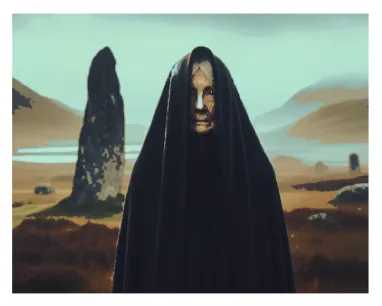
A Keening Woman with Standing stones.
Credit: Jude Lally
The Keening Woman was often old, barefoot, and would arrive at wakes in exchange for a glass of whiskey or a small amount of food. The keen itself was a highly specialized craft that combined eulogy, poetic verse, song and wailing, and was employed to conduct the grief of the community and guide the soul of the dead from this world. While much of this practice has been lost or stolen by history, enough remains to carry the spirit of the tradition into the modern world. According to Lally, it’s desperately needed.
This interview has been edited for length and clarity.
How did you get started teaching these ancient traditions?
I lived in Asheville, North Carolina for a while, and when I landed there, I had absolutely no idea that people were interested in their Scottish and Irish roots. They would tell me where their ancestors were from. It turns out that when folks came over originally, a lot of them just kept migrating down the coast, and that has resulted in a strong connection between southern Appalachia and Ireland and Scotland.
I felt so much for those ancestors. Some of them were glad to leave because of terrible conditions and poverty, but for many of them, especially the older folk, it might not have been their choice. They were swept up in the Highland Clearances (the forced evictions of tenants starting in the mid-18th century). That was my first thought, that those people were never able to go home again. And the more I talked to people, the more they expressed interest in honoring those ancestors. So I started hosting workshops to help people engage with those roots and make them tangible.
Why the focus on grief and keening?
I really made peace with grief when I was little. I always thought, “Today’s a good day to die, everything is in place, everything is fine.” But I never chose grief or keening. That was the extent of my griefwork, and I wouldn’t have touched this stuff with a bargepole if somebody hadn’t invited me. I find with a lot of things in life, you don’t have a choice. You’re invited.
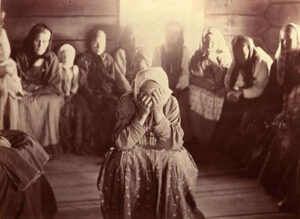
A Keening Woman.
Image credit: jenikirbyhistory.getarchive.net
I had a good friend who lived near me in North Carolina, and she had terminal cancer. She had tried everything; alternative medicine, doctors, clinical trials. None of it worked. We were making little pottery figurines inspired by old European traditions, because she wanted to put them all around where she lived before she died. I asked if she would hand me a tool, and she just turned around and asked if I would keen at her wake. I looked at her, and she might’ve been speaking another language. I could only say one word, so I had to say yes.
I had heard of keening, but I had no concept of how to do it. And I read and I tried things with friends, but I was really just thinking that it had to come from within. At that point, learning a keening song was beyond me. I didn’t want to prepare for it. I didn’t.
When I got to the wake, they were waiting for somebody to basically start things. So I just started humming and making noise, and walking about the edge of the room. They would lean into me for voice, and I felt then that anybody who was tuned in could’ve just done it.
After she was buried I wanted to listen to some Scottish laments, and there’s a song called “Ailein Duinn,” or “Dark-Haired Allan,” and when I heard it I just got goosebumps. The spelling was A-L-L-A-N, and that was the spelling of my younger brother’s name. He died in 2008, he was only 35. I felt it was like a nudge from him.
Later when I was offering an Imbolc workshop, I decided to include the song at the end. I taught it to everybody there, and extended this invitation for them to take whatever grief they were holding and use the song as a container. To lean into the song, let it hold their grief and move it. I had never done anything so cathartic. When people started telling me how it changed their relationship with grief, I realized that I needed to keep doing it. Even if I didn’t really know exactly what “it” was.
What do you think these practices have to offer us in our death- and grief-phobic Western culture? Is the idea of keening in conflict with the way we tend to view death and dying?
I think it’s in conflict enough to knock us out of our illusion of separateness. If you go to a funeral, what’s the one thing you’re trying not to do? Show any emotion. It’s the most ridiculous thing. My mother’s friend died and my parents were away, and you could just feel it coming up in you at the funeral, and if somebody were to make a noise, you would just crack open. We are so under society’s patriarchal rules of how we need to exist. I think sometimes we don’t realize this oppression of grief. Our own indigenous traditions in Ireland and Scotland, as well as around the world, have been pretty much erased. The death industry just takes the bodies away, where women would have dealt with the bodies, now they’re just taken away.
Death is the one thing we can be sure of, but it’s alien. There’s so much shame about it. It’s this working culture with its societal norms. Think about how much leave you get when somebody dies, and then you’re straight back to work. You’re expected to grieve pretty much on your own, which is against all nature. We should be doing it together.
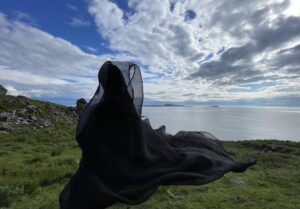
A Keening Woman doll by Jude Lally
What a Keening Woman did was take the community through their grief. She was fulfilling a role of acting out everyone’s grief, but also tapping into her own. And it can be an act of rebellion, in a way.
One of the parts of the keen is the salutation. The Keening Woman had a freedom within that to say what she wanted to say. If someone was an abusive person, she could actually say that. She couldn’t say it at any other time. She couldn’t reference it outside of when she was doing her thing. But she had the freedom to actually say what she thought, and voice what other people thought as well. So I feel there was a rebellion there.
When there was a keen everyone was invited, and after the English outlawed the Irish language, quite often people would come because people were speaking Irish. The Keening Woman wasn’t the only one, and she wasn’t only talking about the dead person. She would have been talking about the people who were in control of the land, using her voice against them. And her voice went to the church as well. So I think there’s a tradition of rebellion there. And I think it’s a huge thing, especially in a culture where women’s voices are silenced, and we don’t always get to have the experience of sharing our own stories.
So you have this one aspect of rebellion and reclamation, but you also talk about keening as a ritual to guide the soul from this world.
What if we imagine death as an old woman, like the Keening Woman, but maybe she’s on the other side. We know from the work of death doulas that people start to see their dead relatives come and sit with them, but the old woman of death is not just there sitting by the bed of your relative, she’s there when the fox gets run down by a car, and the fox ancestors are coming, That’s what the Keening Woman was doing as well.
It must have been such an exhausting role, because not only was she doing this theatrical work, pulling into her own grief and helping the whole community grieve, but she was also fulfilling this other role of moving the soul on to the Otherworld. Standing between both worlds.
Do you think that the Keening Woman, in assuming that role, channels the old woman of death? That she acts as a vessel or a conduit for that archetypal entity?
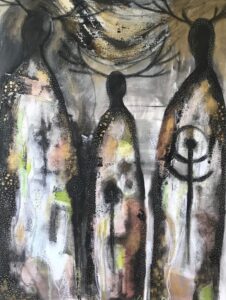
Painting by Jude Lally
Oh I’d imagine. I love the thought that this human woman, when she was tapping into her own grief, was also tapping into something else. Because this was a highly skilled ritual. The songs were incredibly complicated, and she would have learned that from somebody. Was she tapping into her granny who taught her? Or maybe another woman in the community? It was always older women who carried this on, and chances are whoever taught her was dead when she took up the role. So I wonder if she felt those women close to her as she did this.
What is your greatest hope for this Reclaiming Keening series?
Keening comes from the ancient spiritual bedrock of the land, and I think changing our relationship with grief can help us root ourselves back into that, so that we’re more present. Having a grief practice isn’t a little token so that when your mom dies you’re not going to feel it. Of course you’re going to feel it. But you’re present and you’re rooted, and you can be aware of all the cycles of it, and not just have it overwhelm you. So if I can give people tools, whether it’s a place to share stories, to make a doll, or a little bit of ritual that can help change their relationship to grief, that’s what I hope to offer with this.





 Final Messages of the Dying
 Will I Die in Pain?