What is Sacred Body Washing?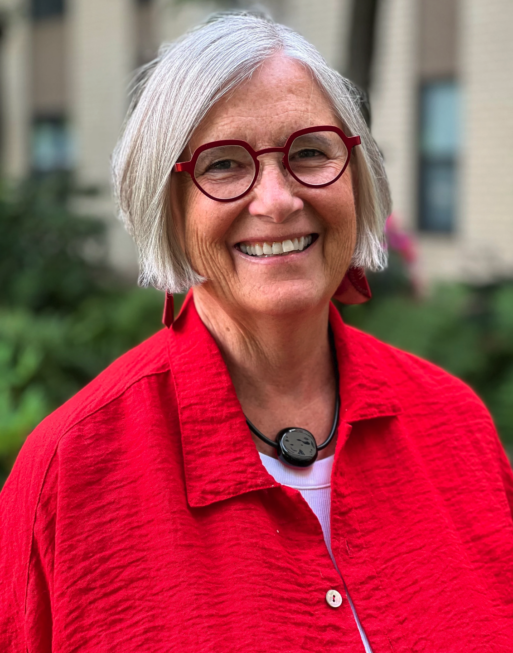
Ellen Hufschmidt of Rites of Change is a ritual artist, author, and grief counselor.
Credit: Ellen Hufschmidt
Many faith traditions include ritual washing of the dead, including Islam, Judaism and Buddhism. This practice is often understood as a final act of care and purification and is performed as a gesture of respect for the deceased.
As a ritual artist with deep roots in grief counseling and caring for hospice patients, Ellen Hufschmidt has found that sacred body washing can be incredibly meaningful for those who are grieving. In her practice, Rites of Change: Transitions with Courage, Hufschmidt guides families through their own unique rituals of blessing a loved one after their death, in body washing ceremonies that offer those who are grieving space in which to process their loss.
Drawing upon earth-based spiritual beliefs and natural symbolism, as well as other faith-based practices she has learned through her chaplaincy, Hufschmidt uses language and imagery that offer comfort, clarity and succor to those in mourning. Her book, “With Our Own Hands: A Guidebook to Ritual Blessing of the Dead,” is an in-depth look into her process and intentions.
“Ritual is a living art form,” Hufschmidt writes on her website. “I create art in participation with my audience that brings peoples’ deep emotions and sense of spirituality to life through visual creations and verbal exchanges. I work with intangible materials: words, gestures, atmosphere, and memory […] the experience itself is the artwork, existing in the moment of its creation.”
In her soft, gentle voice, Hufschmidt shared her experiences in performing sacred body washing and blessing rituals and explains why taking the time to be present in death is such an important part of processing grief.
This interview has been edited for length and clarity.
What is sacred body washing? Can you describe it for us; what are the steps you take?
Well, it happens after death, generally immediately following and up to two or three days later. It all depends on circumstances and how prepared a family is for the process. The ritual can be a blessing or a washing; I give families both options. Some are very sensitive to the idea of seeing a nude body and some think washing is the way to go.
The ritual can be adjusted as we go, and people get more comfortable, depending on how much they’ve thought about this beforehand.
What I’m trying to do is give people — a family — the opportunity to stay in the presence of immediate death. That’s not a common life experience, these days. Maybe older people have had the experience before, but after working 10 years in hospice, the inclination I saw in families was, “Uh oh, I have to leave now. I have to go home. Feed the dog, take a shower, go shopping for funeral clothes.”
Sometimes, people who are very sensitive will feel the air change in the room [when a death occurs]. Other people just don’t know what to do with themselves for fear that they might cry, or because they don’t know what to say. Or, they’ve been there for hours or days, and they just want to go home now. But if I can make that time helpful to them, and bring them into the picture in a meaningful way, it allows them to relax and to actually begin to accept the death, which is very important in the grieving process.
You can’t really grieve until you accept the death. Leaving might feel better at the moment, but it doesn’t help you process it, because we’re not familiar with that. So I want to set a tone that can make it a very special time.
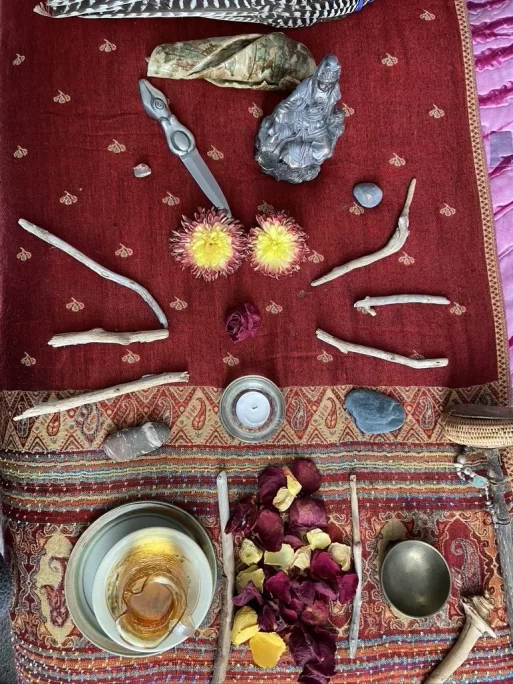
An altar created for a Water Ritual, with items that hold symbolic meaning.
Credit: Ellen Hufschmidt
So I start out by having a big bowl, and pouring water in it. And as I do that, I ask people to remember places where their loved one experienced water, like on vacation, or somewhere they had a good time near water. Maybe it was a fishing hole; maybe it was where they vacationed on a lake. Maybe it was a big journey to a coastal area, or even a flight across the ocean, which is a big deal for some people. So that starts the memories flowing. And if I’m in a group, people will have different associations with water; they may have their own experiences.
And then, as we’re circled around the bedside, I have other questions I like to ask. I have herbs there, like lavender, and we’ll pass them around. I’ll ask people to take a little pinch of lavender. And as we’re doing that, I ask each person to remember something that was very relaxing, very pleasant — a real easy time relaxing with their loved one. And then they put the herbs in the water.
I also use rosemary, because rosemary is an herb that we often associate with memory. And I ask for any memories involving their loved one that were significant; they don’t always have to be good ones. And so that helps a little bit of the storytelling, and everyone goes around sharing.
The last thing I do, usually, is I often have rose petals — either dried or fresh — or we take whatever flowers are in the room or by the bedside, and that just adds more beauty to the ritual. I’ll ask for them to share memories of loving moments, or, if the roses have thorns, maybe some stories about thorny parts of their loved one’s personality. Thorns are for protection; many people can relate to that.
As we perform the ritual, the water starts looking more and more beautiful — I call it sacred water, because of the intentions that were put into it. So we use that water in the ceremony, in the ritual. I give everyone little cotton balls, and then they can dip that cotton ball into the water and make a little blessing. Or say a little something; whisper into the person’s ear or touch their arm, or their heart, wherever they’d like, and do a blessing.
We often open and close with some poems, or some songs, whatever is right for that family. We might light some candles as we start, and then close by blowing them out. We can be very inclusive of the family’s spiritual beliefs, try to use words that are familiar and comfortable for them.
And when we make the bowls, they can last around 24 hours, but then you want to return the water to earth — not cement — but it could be on snow or any kind of earth or other water.
Have you performed many of these? Are there a lot of people seeking this kind of ritual?
Well, certainly not as many as I would like. I’ve probably done 30 or 40. It takes opportunity; some are very simplified and some are more elaborate.
Any specific memorable sacred washings that stand out to you?
I had a very close friend who died of cancer, and when we did her blessing … there was a sense of being tortured in her treatment process. Things just didn’t go as expected. Things were tried, and they didn’t work. So there was an aspect of the ritual which was more like a cleansing. Because we wanted to wash away all that pain, all that frustration, all the things that didn’t work. The cleansing aspect really attracted the family.
In that case, one thing that really stood out for me was that as they were blessing and washing her with these cotton balls, I encouraged them to gently lift up her leg or her arm or something in a small way. And something changed when I suggested that. As we touched her, there was this hesitant silence, and all of a sudden we realized the silence was because when we had been trying to care for her at home, every time we needed to move her in any way there was a painful wince. But all of a sudden, now, after her death, there wasn’t that sound, there wasn’t that response. And it was like, “Oh, thank goodness she’s not feeling any pain anymore.” It was very relieving to us, as the caregivers.
We had taken the freedom to move her bed — often, in rooms the bed is in the corner, but we moved it away from the wall so people could be all around it. And in her case, because she was our Celtic history teacher, we faced the bed to the west; the image of leaving was very important, so we faced her to the west and looking out the window from the middle of the room. We put dried flowers around after we had washed her and laid her favorite quilt over her. She was just gorgeous. The flowers from the sacred water, these little rose buds, had sort of fallen along her hairline, and she looked like she had a crown of roses. It was just beautiful.
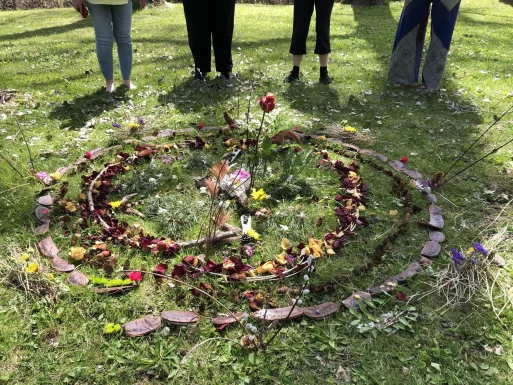
After sharing stories, members of a racial awareness group created this spiral collage made from nature’s gifts.
Credit: Ellen Hufschmidt
Why have such rituals emerged?
For me, it started out with a friend whose father was dying. And he had not been very communicable. There weren’t a lot of relatives left at his age, and my friend said that she’d like to do a body washing. It was sort of imagined from our Celtic roots, and our desire to have a more hands-on intimate experience.
So we sort of created it together — and it was so meaningful and successful. In that case, there weren’t a lot of relatives, but nursing care came in to say their goodbyes, and they found it very meaningful. And so I just kept elaborating on it.
The next one was my friend who had so many challenges in trying to overcome her cancer that were unsuccessful. And, that surprised me, because I didn’t bring up the idea until she died. And then her daughter said, “Oh, I’m going to ask the nurse to help me wash her hair. I’d like to cut some, to give away to make wigs for other people.” And so I asked if there was any interest in washing and blessing her body, and they said “yes.” Which kind of surprised me. The mixture of my friend’s husband, and there were two families that were very close, they raised their children together, and they were all there and I thought they would just have me do it and they’d observe. But no, they all wanted to be involved in the process.
Who performs this washing — family, friends or someone like you who assists?
So, I’m a ritual artist, and I’ve been creating this for a long time now. I’m not so much by the bedside anymore.
I’ve done it for groups where we’re more in teaching mode. Where it’s lots of people, with lots of stories. So they will frequently go up, and I’ll have a living person stand in for a dead person, so that people can go up and they’ll whisper in their ear, and still move through a lot of grief.
Sometimes people couldn’t be at a relative’s funeral or viewing, if they were out of town or indisposed for any number of reasons, and so they missed that opportunity, that intimacy. What I’m providing is some intimacy in very simple ways. And they’re always so grateful to have had that opportunity.
Unexpected things happen every time I do this. I just bring a framework and encourage people to relax, to be present, to tell their stories, and they just sort of free up and things happen that we don’t expect. All of a sudden a song will come to a family member, and they’ll want to sing it together. Or I have opening and closing poems or songs in case the family doesn’t have something particular.
I assume some people are not comfortable with washing a naked loved one. How do you handle this?
In one case I was called, because I was a grief counselor in a hospice in Duluth, for this patient who was a teenage girl who had had cancer most of her life. She was well known in the community. The chaplain there called and said that there were so many people there from the family, and it was a little overwhelming for the facility and staff. And there’s some fear that the mom won’t want to ever leave the room, which was understandable. This was her daughter. So I went, and asked the room full of people if we could go out into a waiting area, to hold a kind of vigil.
So I led the group through the ceremony out in the waiting room, which could fit more people. We made the water, and, initially, the girls’ father had just wanted a blessing. But in the middle of the ritual, the mother changed her mind. The girls’ chest was scarred, and she had gained a lot of weight from the treatment, so there was a distortion. As a teenage girl, that was very painful for both her parents to see. And the mother said she wanted to wash her. I asked the father if it was okay — he said yes, he saw how important this was to his wife.
So I told everybody what we wanted to do, and I asked the female relatives and the women closest to this young woman to come in and be close, to circle in to provide the mother some privacy. And to the rest of the people, I said, “Now I’d like you to just hold the space and either lower your eyes, look down, or you can turn your back if that’s more comfortable, to help build this circle of privacy.” And they all agreed to do that. And the mother washed her chest – it was very scarred, like with stretch marks, in a kind of pattern. The mother was very relieved to be able to do this.
When we finished, we were able to end the ceremony, and everyone was satisfied. The mother was more able to release her daughter, and start saying goodbye and thanking people.
Is there a way people could incorporate this ritual on their own?
Everyone can do it in their own way. When we were in COVID I did many of these online, and I still do, where we go through the ceremony but it’s online, and everyone’s making their own individual altars. It’s quite beautiful.
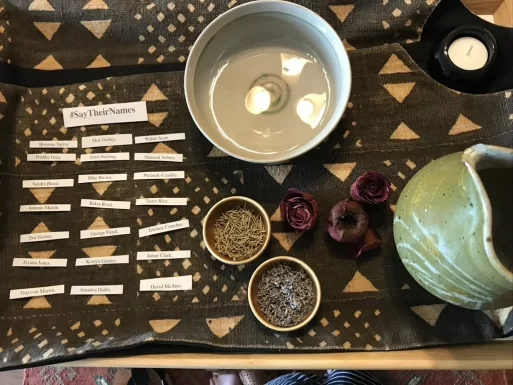
An altar for a Water Ritual dedicated to victims of racial violence.
Credit: Ellen Hufschmidt
Amazing things happen at the time of death, and right after death, and many people can’t remember what happened. You know, they’re just exhausted, tense, trying to maintain appearances for the funeral. They’re just so stressed out that they really don’t remember. But something like this, they remember. It’s a gentle process.
As for people who are grieving, I encourage them to make altars in their homes. This can be some time after the death, or immediately following, just in the living room or even on their dining room table. Or it could be in a niche someplace, or on a dressing table.
Just bring out a cloth, and put out sacred objects that remind you of your loved one, spirituality symbols, artifacts of your loved one’s life. One person told me once, “I know what I’m bringing: His hiking boots!” Other people have photographs, pictures, jewelry, watches, books.
So all things come to the table, and you should try to make it beautiful, with fabric or a piece of clothing, and make it meaningful.




 Who Cares for the Caregivers?
 Final Messages of the Dying