US Life Expectancy Hits All-Time High
Our average life expectancy continues to reach new highs.
Credit: Andrii Zastrozhnov from Getty Images, via Canva
Life expectancy is a fundamental measure of a population’s health.
This statistic acts as a snapshot of the current population’s mortality rates. Derived from sex, race and other characteristics, it is the estimated average number of years a baby born in a given year might expect to live.
According to data released by the National Center for Health Statistics at the Centers for Disease Control and Prevention (CDC) in late January, the average U.S. life expectancy for 2024 rose to 79 years, the highest mark in American history. Although some of the numbers are cause for celebration – like overall declines in drug overdose deaths – many experts say that any positive trends are due to hard work and advocacy. It isn’t yet time to rest on our laurels in regards to public health.
Charting America’s Health Trends
For decades, U.S. life expectancy rose – at least a little bit – almost every year, thanks to medical advances and public health measures. The previously recorded high point was set in 2014 at just below 79 years of age.
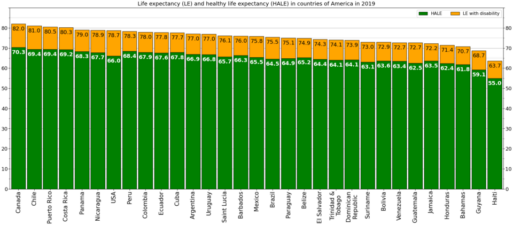
US Life Expectancy in 2019, as compared to other nations (before COVID dramatically impacted our upward trajectory).
Credit: The Global Health Observatory, via Wikimedia Commons
That number held relatively steady for several years until the COVID-19 pandemic killed more than 1.2 million Americans – causing life expectancy to plunged to 76.5 years in 2020. It has been on the rebound ever since.
(It is important to note that despite these signs of improvement, the U.S. still has a lower life expectancy than most other high-income nations, a gap that widened after our response to the COVID pandemic, and is driven by higher rates of death from chronic diseases, drug overdoses, violence, accidents and infant mortality – despite the U.S. spending more on healthcare.)
Key Findings of the CDC’s Latest Data
“Mortality in the United States: 2024” is the first public release of final mortality data for that year from the CDC. (Death statistics for 2025 are not yet finalized, making these the most current numbers.) The key findings, in addition to the 0.6-year increase from 2023, revealed promising statistics regarding the future of our public’s health.
According to the report, in 2024 about 3.07 million U.S. residents died, which is 18,000 fewer than the year before. Death rates declined across all racial and ethnic groups, to varying degrees.
“Despite higher than average declines, American Indian men and Black men continued to have the highest age-adjusted death rates in 2024, about 1,200 deaths and 1,000 deaths per 100,000 people, respectively,” CNN reported.
Overall, women can still expect to live a few years longer than men. But the CDC data shows that that gap is shrinking: the life expectancy for women increased by 0.3 years to 81.4 in 2024, while life expectancy for men increased 0.7 years to 76.5.
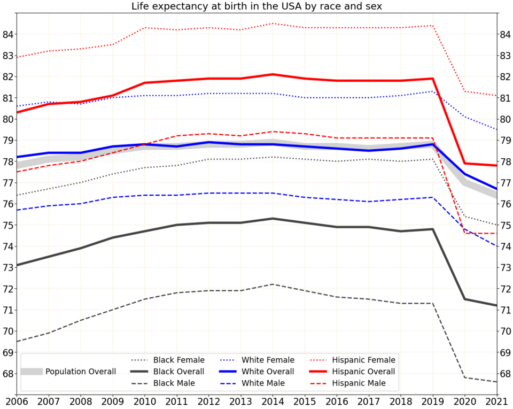
US Life Expectancy by race and gender, in 2021, shows the impact of COVID-19
Credit: National Vital Statistics Reports via Wikimedia Commons
In one key takeaway, the numbers showed a lasting improvement in the drug overdose epidemic, Andrew Stokes, a researcher at Boston University told KSAT. The category under which drug overdoses are categorized, “deaths from unintentional injuries,” fell the most, dropping more than 26% according to another report.
Finally, the report also revealed that although heart disease is still the nation’s leading cause of death, that death rate dropped by about 3%, for the second year in a row.
“The good news is that, overall, fewer people are dying from any cause,” Latha P. Palaniappan, a professor of cardiovascular medicine at Stanford University, told the American Heart Association. “However, about half of all U.S. adults continue to have some form of cardiovascular disease. Those rates are still higher than they were before the pandemic, and persistent increases in common conditions like high blood pressure, diabetes and obesity continue to drive the risk.”





 Who Cares for the Caregivers?
 Final Messages of the Dying