“Twilight of Death,” the “Third State,” and Advances in Postmortem Biology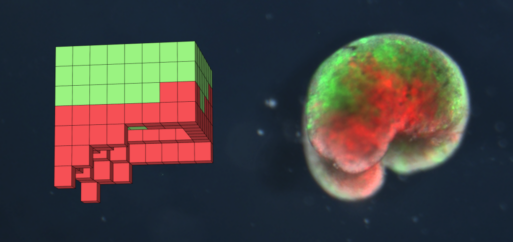
Images of a xenobot, a computer-designed organism.
Left: a computational design of a xenobot. Right: the deployed physical organism, built completely from biological tissue (frog skin is green, and heart muscle in red).
Credit: Sam Kriegman, via Wikimedia
Medical innovations and interventions have progressed to the point that doctors and scientists are finding it more difficult to conclusively define when we die.
Some fascinating recent studies that delve into postmortem biological functions are revealing that our current understanding of death might be outdated, with implications that could dramatically impact what we know about transplantation, cancer and forensic research.
“Twilight of Death”
Usually, scientists consider death to be the irreversible halt of functioning of an organism as a whole. In regards to modern medicine, however, there are multiple definitions of death: cardiopulmonary death, whole brain death, brainstem death and higher brain death, for example. (Often, the specific definition of death that is used depends on various circumstances, particularly in regards to organ transplantation.)
One reason for the flexible terminology is the fact that, as practices like organ donation highlight, some organs, tissues, and cells can continue to function even after an organism’s demise. A team of researchers led by Peter Noble, associate professor of microbiology at the University of Alabama in Birmingham, and Alex Pozhitkov, senior technical lead of Bioinformatics at Irell & Manella Graduate School of Biological Sciences at City of Hope, recently conducted a review of multiple previously published studies on postmortem biology, and coined the term “twilight of death” for this ambiguous period.
“The Third State”
In their findings, published in the American Physiological Society’s journal “Psychology,” the team argues that the “twilight of death is fertile ground for scientific inquiry,” citing potential impacts on medical interventions, organ transplantation and the possibility of “reversing the state of ‘dead entities’ back to life or triggering a transformation into something new.”
Although it sounds like science fiction, some researchers have already been successful in their attempts to reveal these microbiological Frankensteins. Noble and Pozhitkov’s review looked at several studies that found that certain cells exist in a “third state,” a unique phase after an organism’s death that allows for a metamorphosis distinctly different from other biological, “preprogrammed” transformations (like when a caterpillar turns into a butterfly.)
These studies were able to conclude that cells in the third state, when provided with nutrients, oxygen, bioelectricity or biochemical cues, have the capacity to transform into multicellular organisms with new functions after death.
Xenobots and Anthrobots
In one study the team reviewed, researchers found that skin cells extracted from deceased frog embryos were able to adapt to the new conditions of a petri dish in a lab, spontaneously reorganizing into multicellular organisms called xenobots.
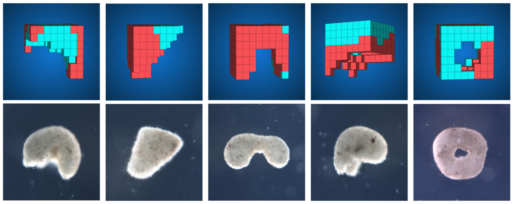
An image comparison of AI-designed xenobots and their actual, cell-based constructions that realize living systems with predicted behaviors.
By Kriegman, S., Blackiston, D., Levin, M., Bongard, J.
In a separate article published in “The Conversation,” Noble and Pozhitkov wrote, “These organisms exhibited behaviors that extend far beyond their original biological roles. Specifically, these xenobots use their cilia – small, hair-like structures – to navigate and move through their surroundings, whereas in a living frog embryo, cilia are typically used to move mucus.”
Furthermore, Noble noted, xenobots are able to kinematically self-replicate, meaning they can physically replicate their structure and function without growing.
In a similar study, researchers found that solitary human lung cells can self-assemble into miniature multicellular organisms, called anthrobots, that can move around and navigate their surroundings, as well as repair both themselves and injured neuron cells placed nearby.
Possible Implications
It is hoped that someday, cells existing in the third state could be used to develop new therapies and biotechnology applications. For example, arthrobots could theoretically be engineered from a patient’s own tissue to deliver drugs without triggering an immune response, Noble conjectured. Or they could dissolve arterial plaque in atherosclerosis patients, or clear excess mucus in those with cystic fibrosis. Third state cells could also dramatically change organ transplantation procedures, expanding the time window for harvesting viable organs and reducing the rate of rejection.





 Who Cares for the Caregivers?
 Final Messages of the Dying